Showing posts with label 3-D Film Archive. Show all posts

Tuesday, April 13, 2021

Silent Madness (1984)


Silent Madness was one of those movies that just had a bad sense of timing all around. It came out too late in the 80s slasher craze to make an impression. By the time it was released in 1984, there had already been 3 sequels to Friday the 13th, two to Halloween, and innumerable knock-offs with such titles as My Bloody Valentine, Prom Night, Terror Train, Happy Birthday to Me, and so on. It also came out the year after 3D's big year so nobody was showing 3D movies at that time. It also came out right at the same time as Nightmare on Elm Street, which just totally bumped it out of theatres. As such, very few people saw it as it was originally intended. It didn't help the movie any that it doesn't really do anything that any other film in the genre does. In a bizarre way, it's a mash up between Halloween and the first Friday the 13th. 

The movie starts at Cresthaven Mental Hospital, somewhere in Manhattan. Cresthaven is overcrowded and understaffed, so a couple of incompetent doctors decide to release people back into society that they figure aren't a danger. Due to an absurd clerical error, one Howard Johns, a dangerous psychotic, is released instead of a simpleton named John Howard. Fearless Dr. Joan Gilmore (Belinda Montgomery) tumbles to this and tries to warn the upper management. They brush her off and claim that Johns is actually dead. Meanwhile, Johns somehow manages to get back to his old stomping grounds, Barrington School For Girls. See, Johns was the janitor there 20 years ago when he snapped and killed a bunch of sorority girls with a nail gun. How exactly Johns gets back to the college is never explained especially when we're told the school is over three hours away from the hospital. No matter. He's back and killing a new batch of sorority girls, some of whom don't even get names. Gilmore takes a weekend off and goes back to the school to track Johns down. The hospital decides to cover up and sends two demented orderlies after both Gilmore and Johns. 

Did you follow all of that? No. Doesn't matter. With a film like this you just tend to go along for the ride and enjoy the kills. Even when they're done with a hilarious cartoon ax.

The most creative thing the movie seems to have done is had then 34 year old Montgomery playing the film's Final Girl and not one of the teenagers. Montgomery does what she can with this, but while she seems to be trying to give a performance, Viveca Lindfors as the House Mom and Sidney Lassick as the Sheriff decide to say "to heck with it" and go wildly over the top. As do the insane orderlies. In fact, Montgomery seems to be the only one in the film not overacting!

At the end of the day this is your standard issue stalk and slash. The victims barely have names let alone personalities and the killer is the usual mute madman. Gore hounds will be a little disappointed that a lot of the admittedly inventive kills cut away before getting too gory and there's very little nudity for this type of thing. Is it better than it's kissing cousin Friday the 13th Part 3 in 3D? Maybe. The characters act a little less stupid. Well, most of them. The orderlies aren't particularly bright and neither is Lassick's sheriff. Some of the actors are a little better than in the 1982 slasher but that's a pretty low bar to be honest. Bizarrely, there's not one night scene anywhere in the movie. The only other slasher film that I can think of anything like that is the miserable 1997 3D cheapie Camp Blood, a movie so bad it makes this one look like Citizen Kane.
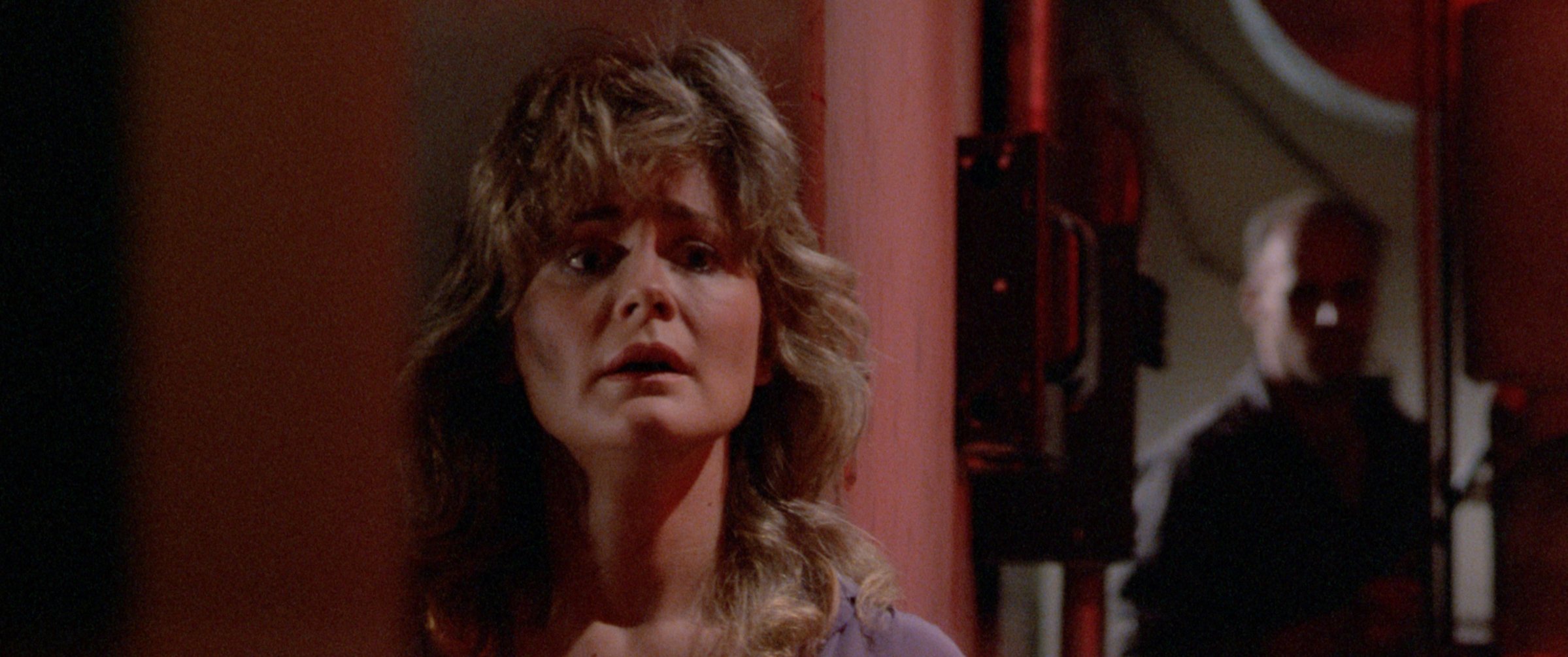

All things considered, I kinda like this movie. No, it's not very good. As I've pointed out before, none of the 80s 3D movies are any good, but this one is one of the slightly better ones. It's not something I'd watch every month or even every year, but I can see myself returning to it from time to time if only to get a laugh. 

Silent Madness came and went in October of 1984, overshadowed by Nightmare on Elm Street. It had a VHS release and a poor bootleg 3D version that wasn't even in the full widescreen. It's long been neglected and mostly forgotten except for by die hard slasher fans and 3D fans. Vinegar Syndrome and the 3D Film Archive decided somewhere along the way that Silent Madness was worth saving and now there's a beautiful 3D Blu Ray of it available. The Blu Ray includes 3 versions of the film: a 3D Blu Ray version requiring the proper TV and Blu Ray player, a 2D version (of course) and an anaglyphic (red/cyan) version that is probably the best anaglyphic video presentation I've ever seen. There's also a mess of extras on it including a fairly interesting documentary on the making of the movie and the original sizzle reel done for the movie.


If you're a 3D completist, you obviously need this disc. The 3D Film Archive worked their usual magic on it and as such it looks a lot better than most of the other 80s 3D films that have gotten a 3D Blu Ray release--Friday the 13th Part 3 included. The inclusion of the anaglyph version allows a wider audience to watch the movie in 3D. As I said, it's a much better anaglyph version than anything I've seen over the last 40 years of watching these things. Supposedly the 3D Film Archive will be doing this more and more on future releases.

I met Belinda Montgomery a few years ago at a Chiller Theatre convention and admitted to her that I liked her in a movie that I knew was a stupid movie. When she asked which one, I mentioned this one. She rolled her eyes and said "That is a stupid movie!"

Yes, Ms. Montgomery, it really is. But I kinda get a kick out of it.


Thursday, May 21, 2020

3-D Thursday: Revenge of the Creature (1955)


There's several notable things about 1955's Revenge of the Creature: it was the last 3-D movie of the 1950s, the first 3-D sequel to a 3-D movie, the first 3-D movie shown in 3-D on non-cable broadcast, and personally speaking, the first 3-D movie I ever saw.  It was in May of 1982 and it was an anaglyphic broadcast, the first in the Philadelphia region. Though it really didn't work at all, my 11 year old brain was convinced it did. Mercifully, Universal and the 3D Film Archive restored the film and have released it on 3D Blu Ray which works beautifully.

Revenge picks up a year after the original Creature From the Black Lagoon. The Gill Man is still hanging out in the Amazon. Ocean Harbor Oceanarium sends George Johnson (Robert B Williams) and Joe Hayes (John Bromfield) to capture the Gill Man for scientific study. They enlist Lucas (Nestor Paiva), the boat captain from the first film, to take them to the Lagoon. After a near fatal encounter with the Creature, they manage to capture him and take him back to Florida. Once there, he's studied by Animal Psychologist Clete Ferguson (John Agar) and Ichthyology student Helen Dobson (Lori Nelson). He falls for Helen but gets sick of being hit with bull prods so he eventually escapes, wrecking havoc and killing Joe.  His downfall comes when he kidnaps Helen from a seafood house.

Revenge is not quite as good as it's original. The first half has too many comedy bits in it. First there's Lucas, but he's not too much and anyway, I always liked his character. Then we get some humor with a chimp followed by Clint Eastwood in his first role as a dumb lab tech with a rat in his pocket. It's neat to see Eastwood when he was so young, but the scene is disposable. Then we get Flippy the educated Porpoise who serves no purpose to the film outside of filler. Revenge was shot at Marineland in Florida and much like Jaws 3-D acts as a bit of an infomercial for Sea World, so does Revenge for Marineland. Mercifully the second half does away with Flippy and gives us some good Creature chaos with the Gill Man flipping over cars and tossing around college students like they're frisbees. There's also a few callbacks to the original in the second half. If the first half had been as strong as the second, this would have been fully as great as the original Creature. Unfortunately, the filler makes it a lesser entry.

The cast is good, though not quite up to the casting for the first film. John Agar did a bunch of these things back in the 1950s. This might be his best film. Lori Nelson is attractive enough and you can argue if her or Julia Adams is sexier. The scene in the motel room where she gets ready for a shower is surprisingly sexy for the 50s and predates Janet Leigh's ill-fated shower in Psycho by five years. But the triangle between Agar and Bromfield for her affections doesn't quite have the tension that existed between Richard Carlson and Richard Denning in the original. Paiva and Creature actor Rico Browning are the only two major actors to return from the original. Paiva is great as usual and gets the one genuinely funny line in the film when he says "I hope you're not going to blow up my boat, Mr. Johnson. Like my wife, she's not much but she's all I got". Browning, by the way, is the only actor to appear in all three films. He later assistant directed the underwater sequences in Thunderball. This was also the fourth and final 3-D film directed by Jack Arnold. Arnold held the record for directing the most theatrical 3-D films until Robert Rodriguez did five in the current era.

For decades, most people who got to see this in 3D only got to see it in anaglyphic format, whether it was anaglyphic on TV or 16mm. The 16mm print looked better than the TV print, of course, but seeing it as it was originally intended is an eye opener. The 3D Film Archive did a gorgeous job on this. The 3D is absolutely perfect here. Shots that were in reverse 3D for decades have been corrected and the alignment has been corrected shot by shot. It actually looks better on 3D Blu than the original film. The 3D version is included in the Creature Legacy Collection Blu Ray Set. There was some controversy as Universal accidentally released the 3D version in a Side By Side format as opposed to 3D Blu Ray format, but that's been corrected and the new version looks great. The depth is outstanding and the pop-outs memorable, especially when Agar hits the audience with the bull prod, the one effect that worked in the anaglyphic TV version.

One of the complaints about the film is that taking the Creature out of the Amazon removes much of the terror and mystery of the first film. This isn't totally incorrect though I still think the filler in the first half is what really drags the film down. When it's trying to be suspenseful and scary, it works wonderfully. The opening in the Amazon and the Creature's rampage when he escapes from his captivity are marvelous. The motel room scene is pretty creepy, too. All in all, it's at least half a worthy sequel that just slightly misses the mark. But thankfully we can see it the way it was meant to be seen, since this works much better in it's 3-D format than 2-D.

Wednesday, May 20, 2020

Why 3-D Isn't As Dead As You Think


Once again, another source, Cheddar News on YouTube, has proclaimed the Final Death of 3-D. Of course, they've done so with a ton of misinformation. What's particularly sad about this is the attempt to educate us about 3-D while knowing nothing about it. So let's go through this once again: 3-D is not as dead as you think or the haters want. Sorry to disappoint the haters.

Let's talk a little about the history for 3-D for a moment. The earliest 3-D experiments date back to at least 1915 with the first feature in 3-D being in 1922. The Cheddar News video does correctly attribute these to being in the anaglyphic (red/cyan) format. There was a mini-boom in the 20s, mostly shorts with a couple of features. Why did it go away in the 20s? I would think mostly because the big experimentation was for sound. Sound and the Great Depression put a kibosh on a number of film experiments at the time, including Widescreen.

During the 1930s, polarized 3-D was being developed. One of the earliest polarized films was shown at the 1939 World's Fair in NY, a stop motion film called In Tune With Tomorrow. It was remade the following year in color as New Dimensions. The shorts were done in dual strip polarized 3-D. According to Cheddar, polarized glasses as yellow and brown as opposed to red and blue. What this proves is that the person doing the video hasn't actually seen any 3-D movies, especially polarized ones. Polarized glasses are clear and made of polarizing filters that are at a 90 degree angle to one another. Yellow and brown indeed.

World War II put a hold on further 3-D experimentation until the 1950s. And frankly, 3-D has pretty much been with us in one way or another ever since. Don't believe me? Let's look at the evidence.

It's generally accepted that Bwana Devil kicked off 3-D in the 1950s, but you can actually take it back a year to the Festival of Britain in 1951. A number of 3-D shorts were shot and shown there and almost all of them ended up in America in early 1953 after the success of Bwana Devil. Bwana Devil and 99% of all the 3D movies of the 50s were done in dual strip polarized 3-D. There were a couple of part 3D Burlesque features in anaglyph, but the mainstream stuff was all polarized. How does dual strip polarized 3-D work? It's shot using two cameras, one for each eye. It's then projected through two projectors. The two projectors have to be in perfect synchronization. The screen has to be an actual silver screen to reflect the light back. And the polarizing filters that the image passes through on the projector have to be changed every few days. They also have to be clean of smudges and fingerprints, as do the glasses. In short, projection of dual strip 3-D was a very precise science and if just one thing went wrong, the whole presentation would blow up.

Naturally, projectionists didn't care to be that precise. If they couldn't get it to sync up right away, they'd just let it go. Even one frame out of sync can lead to headaches and nausea. There reports of film being a full 24 frames--one full second--out of sync. To give you an idea of what that might look like, picture watching House of Wax and your left eye sees a medium shot of Vincent Price and your right eye sees a two shot of Price and Charles Bronson. The theater owners would cheap out as well, painting the screen instead of installing a proper silver screen. The projectionist union demanded two projectionists in a booth for 3-D shows, 3 if the magnetic stereo soundtrack was involved. Theater owners fought that, too. The end result was many shoddy presentations which left patron sick. Audiences began avoiding 3-D movies for this reason.

While all this was going on, 20th Century Fox was developing CinemaScope, a widescreen process that only used a single projector and a special lens. Theater owners, projectionists, and eventually audiences preferred this over the precision of 3-D, so many 3-D movies started getting flat showings only. Universal rolled out one last 3-D movie in 1955, Revenge of the Creature, and that as they say was that.

But not quite. As early as 1957, 3-D movies were being successfully reissued. The first new 3-D movie after Revenge of the Creature was also the first one released in 3-D and CinemaScope: September Storm in 1960. September Storm became the last dual strip 3-D movie. The following year, The Mask became the first of the part 3-D releases, with 3 segments in anaglyphic 3-D. This was followed by a pair of Nudie Cuties also in part 3-D in 1962, The Bellboy and the Playgirls and Paradiso. A third Nudie Cutie, Adam and Six Eves, was shot in 3-D but released flat until it made a 3-D Blu Ray debut last year courtesy of the 3-D Film Archive and Kino. 3-D took another four years off before returning with 1966's The Bubble, the first single strip polarized 3-D film. Single strip 3-D was supposed to solve the problems of projection. Each image was printed on the same strip of film, either side by side or over and under. They were then projected--again on a silver screen--through a special beam splitter. The whole thing should have been idiot-proof. Never underestimate the idiocy of the American projectionist, however. I've seen far too many single strip presentations that were sometimes painfully mis-projected: the wrong type of screen, the wrong type of beam splitter, the beam splitter not put on correctly, as well as the film being cut incorrectly by the projectionists all could and did wreak havoc on unsuspecting audiences for literally decades.

Nonetheless, The Bubble begat a system that was used for decades. It was followed by Paul Naschy's La Marca del Hombre Lobo in 1968, released in the US in 1971 as Frankenstein's Bloody Terror. 1969 gave us the infamous porn The Stewardesses, which set off a decade of similar films. There were some mainstream films in the 70s, including the part 3-D horror film The Flesh and Blood Show,  the 1974 gorefest Andy Warhol's Frankenstein,  the 1976 South Korean Kaiju flick A*P*E, and a couple of Kung Fu movies. While not everything was mainstream, 3-D was still alive and kicking for practically the whole decade.

3-D took a 3 year break before returning with Comin' At Ya! in 1981. That film started a new mini-boom that lasted until 1985 and produced 18 movies in 3-D. Maybe not as much as the 50s boom, but 3-D was very front and center for a few years in the 80s. Why did it die this time? I suspect projectionists had something to do with it as well as the simple fact that all 18 movies are actually terrible movies. The 50s had some bad films, too, but by and large the 50s batch was pretty good. There wasn't a single good movie released in 3-D from 1981 to 1985. I know because I've seen most of them. I can't imagine that the few I haven't seen are much better than the ones I have.

Six years went between 1985's Starchaser: The Legend of Orin and 1991's Freddy's Dead: The Final Nightmare, which was another part 3-D anaglyphic affair. But that's not the full story, either since IMAX 3-D was ramping up starting in the mid-1980s and Disney was having a lot of success with Captain EO at their theme parks. In fact, IMAX 3-D (and porn ironically) carried 3-D through the 90s. And it was an IMAX 3-D release, James Cameron's 2003n Titanic documentary Ghosts of the Abyss, coupled with that same year's part 3-D anaglyphic release of Spy Kids 3-D: Game Over that set the current boom in motion. But even before that there were a few more mainstream releases: a terrible 1995 film called Run For Cover with Adam West in it and a 1997 Charles Band horror comedy called The Creeps. Plus there were 3-D made for video horror films in the late 90s like the atrocious Camp Blood. To say nothing of all the theme park attractions in 3-D like T2 3D: Battle Across Time, Shrek 4-D, MuppetVision 3-D, etc.

Ever since Spy Kids 3-D, there hasn't been a year without 3-D movies. Part of the longevity now seems to be the fact that projection is finally Projectionist-proof. Outside of forgetting to turn the 3-D filter for the projector on (I've seen this happen), there's no way the image can be screwed up nowadays. It also helps that there's much better movies being made nowadays as opposed to the batch from the 60s through the 90s. While there's definitely been some stinkers in the past 17 years, there's been plenty of movies like Hugo, Gravity, Life of Pi, the various Marvel and Star Wars movies, etc. that can stand alongside the classics of the 50s. The circular polarized glasses are better, too. More comfortable and you can tilt your head without losing the effect. Of course, Hollywood did itself no favors with some lousy rushed conversions like Clash of the Titans, but now even the conversions look great. Watching The Force Awakens or The Walk, you'd hardly believe they weren't actually shot in 3-D.

Yes, there's not as many 3-D movies as there were 7 or 8 years ago, but there's still some high profile releases. Yes, TV manufacturers stopped making 3-D TVS, but you can still get 3-D projectors for the home. Frankly, bigger is better with 3-D anyhow. There's a huge difference between seeing The Force Awakens in 3-D on a 50 inch TV screen and seeing it on a 100 inch projection screen. And while it is also true that not as many 3-D Blu Rays are being released in America, you can still get many of the big releases from Europe. I've gotten the last half dozen Marvel movies and the last 3 Star Wars movies all from the UK on 3-D Blu Ray, and all region free. On top of that, the 3-D Film Archive is still releasing several titles a year on 3-D Blu Ray. Taza, Son of Cochise will be out from the 3DFA and Kino later this month. And unless Covid-19 kills movie theaters totally forever, there are some high profile releases coming this fall like Black Widow and Wonder Woman 1984.

So no, 3-D is not totally dead. And it really hasn't been totally dead for nearly 70 years. Even when it goes away, it only goes away for a few years before poking back up in some fashion. The longest gap between movies since the 50s has been five, and that was right after Revenge of the Creature. All the other gaps have been an average of 3-4 years. So I have to say it: 3-D, like the Force, will be with us always.


Friday, May 15, 2020

The 3-D Nudie Cuties Collection


In between the Burlesque shorts of the 1950s and the Hardcore porn of the 1970s there was a brief period of time where Nudie Cuties titillated our imaginations. Nudie Cuties followed through on the promise of the Burlesque short by actually showing us naked women, but didn't go as far having anyone have sex like what would follow in their wake. They for all practical purposes were almost innocent in their content and the way they dealt with their subject matter. Perhaps too innocent, which is why they only lasted a few short years before giving way to porn as we know it today. But in that time, a few notable people shot them, including Russ Meyer, H.G. Lewis, and Francis Ford Coppola. Naturally, 3 Nudie Cuties were shot in 3-D in between 1960 and 1962,  The good folks at the 3D Film Archive and Kino Lorber have revived two of them for modern audience perusal.

First up is The Bellboy and the Playgirls, one of two such Nudie Cuties directed by Coppola.* The producers of the film took a 1958 black and white German sex comedy called Sin Began With Eve and told Coppola to shoot some color footage to insert into the film. It was decided to do the finale in 3D, making this one of those part 3D affairs from the 60s and 70s. Most reports say that the 3D footage runs about 20 minutes. It doesn't. It's 14 minutes from beginning to end. Which means we have to endure nearly 80 minutes of some unfunny 2D material.

The film starts off promisingly with a great opening theme. Unfortunately, it's downhill from there. The plot, such as it is, is two-fold. The German footage concerns the trials and tribulations of a theatrical troupe. The director is trying to convince his prudish leading lady (future Bond girl Karin Dor) to do a sex scene on stage by telling her tales of sex through the ages. How exactly that was supposed to convince her, I'm not sure. The color footage concerns George (Don Kenney), the titular bellboy of the Happy Holiday Hotel, who wants to be the House Detective and be popular with women. George is determined to find out what goes on in Room 229 of the hotel, where there are a bunch of naked women, one of them named Madame Wimpepoole  (Playboy bunny June Wilkinson, here credited as June Wilkenson). George assumes she's that type of Madame and all the other girls are Ladies of Ill Refute as Archie Bunker would say. Naturally, the ladies are all lingerie sales models, but George is too stupid to know that. The two plots hang together by way of George, who sneaks over to the theater to observe the director and learn about women then run back to the hotel and screw up.

The problems with this movie are many. It has been accused of being a bait and switch, and not incorrectly. Much of the footage is taken up by George, a character so annoying he makes Jar Jar Binks look like Jonathan Winters. Don Kenney sorta kinda tries as George but his material is hopelessly unfunny. I'm not even convinced it was funny in 1962. Since so much is sucked up by George, there's not a lot of time devoted to exactly why an audience would be watching something like this: the naked women. To make matters worse, the two most high profile women in the thing--Dor and Wilkinson--never even take off their clothes. Dor I can almost forgive given the nature of her character but Coppola blowing getting Wilkinson naked makes me want to smack the man. Wilkinson is frankly the best looking woman in the film. She's also just about the main reason to watch. When the 3D finally shows up, the depth is fairly good and the movie almost lives up to it's potential with a 3 minute segment of just the topless women. Then they bring George back onscreen. Bleh. It doesn't help that some of the 3D footage looks out of focus, no doubt due to either the fact that it was shot on 16mm or it really was out of focus (or both). Watching this, it's hard to believe that a decade later Coppola would go on to direct The Godfather.

Fortunately, there's a second feature to be watched and is it ever a hoot. I won't go so far as to call Adam and Six Eves a good movie, but for this type of movie it's a bona-fide classic. Shot in 1960 using the old NaturalVision rig--previously used on such classics as House of Wax, Bwana Devil, Gog, and Charge at Feather River--Adam and Six Eves was only released flat in 1962. The 3D Nudie Cuties Collection Blu Ray is it's 3D debut. Watching it, I can definitively say 1960s audiences missed out big time.

The movie concerns a fat guy in a Hawaiian shirt prospecting for gold with his wisecracking mule in the desert. He comes across an oasis of beautiful naked women, who do everything under the sun to distract him from his search. He's clueless however, just looking at them with a dopey grin and wondering why they have no clothes on before continuing his search. The donkey comments on everything (no, you didn't misread that). That's literally the plot of the whole thing. But it doesn't matter. If Bellboy and the Playgirls was a bait and switch, this was a bang for the buck if ever there was one. The director wisely focuses his camera on the women, knowing that's what his audience is here for. And my God are the women in this one gorgeous. There's literally someone here for anyone's taste. The prospector's cluelessness is nowhere near as annoying as George and the donkey, while not exactly Triumph the Insult Dog, is actually funny from time to time. Best of all, the movie only runs an hour, so it doesn't overstay it's welcome. To top things off, the 3D in this is spectacular. I mean, it should be considering the camera that was used. But it really looks great. Nice levels of depth and some fun pop outs.

A pair of shorts are also included on the disc, a 1953 Burlesque short called Love For Sale and a study of 3-D Kodachrome nudes from 1951. Both are impressive. It should be noted that Love For Sale was previously available in a cut down anaglyphic version from Something Weird. Seeing it here is a real revelation.

As usual, the 3D Film Archive did a bang up job. The restoration on Adam and Six Eves is perfect. The movie looks like it was made yesterday. Bellboy and the Playgirls doesn't look as good, but they worked with what they had and some of it was never going to look perfect. As a curio and a peek into a time that no longer exists, this is a disc worth getting. Indeed, Adam and Six Eves is worth the price of admission alone. I wish I could say better things about Bellboy and the Playgirls, but that's not the Archive's fault. This disc is literally a case of taking the good with the bad. Fortunately, the good outweighs the bad.

*Coppola's other Nudie Cutie was the 2D release Tonight For Sure. As that film also has Don Kenney in it, this particular reviewer has absolutely no curiosity about watching it. One Don Kenney movie is one too many.

Thursday, May 14, 2020

3-D Thursday: 3-D Rarities Vol II


The 3-D Film Archive has done it again. Five years after the incredible 3-D Rarities from the 3D Film Archive and Flicker Alley, we a second installment that's nearly as great as it's predecessor. There may be a little less this time, but what there is, is wonderful.

Vol. II kicks off with A Day in the Country, a 1953 Lippert short. Originally shot in New Jersey in 1941 as Stereo Laffs and intended to beat the Pete Smith short Third Dimensional Murder to the screen, A Day in the Country basically sat on a shelf until Lippert put it out to cash in the 3D craze that was just getting under way. The short was released in anaglyphic format back then, one of the rare anaglyph releases. Narrated by future Stooge Joe Besser, the short is a pleasant if somewhat goofy affair that, like the Smith short, manages to throw everything it can think of out of the screen at you. Incidentally, this is from the only surviving print, a somewhat faded anaglyph. The image might not be the prettiest, but it's the best we'll see on this one.

If you're a little more highbrow than that, the second short should be more up your alley: The Black Swan, a 1951 ballet short shot for the Festival of Britain. It's incredibly well staged in 3D and makes you wonder why more shorts like it weren't done. A couple of other shorts for the Festival of Britain were included on Volume I, so maybe Volume III could complete the collection!*

Hillary Hess narrates the next part, a 20 minute collection of 3-D stills taken from the mid-40s to the late 50s. It's a fascinating look at a time long gone and Hess's narration brings it even more to life. Most fans praise this segment the most and for good reason.

A very odd short done in 1966, Games in Depth, is up next. Shot by the Polaroid company, Apparently intended for Expo '67 but never released until now. It's a mess of different shots set to goofy music, which is pretty bizarre but worth watching at least once.

The prologue to Frankenstein's Bloody Terror follows. I missed my chance to see the film itself in 3-D a few years ago and this two minute prologue really makes me regret that. Following that and rounding out the shorts section is a trailer for the never released clip documentary, The 3-D Movie. It's sad we'll never see this film as it looked like a ton of fun with clips from The Stranger Wore a Gun and Gorilla at Large among other things.

Then comes the centerpiece of the whole thing, the first Mexican 3-D feature, El Corazon y La Espada. Starring Cesar Romero and Katy Jurado, this is a wonderful little swashbuckler about a Spanish nobleman (Romero) out to take back his castle from the Moors. Jurado is the spitfire looking for the formula to turn lead into gold.  Ponce De Leon is also tagging along, looking for the Rose of Youth. There's a lot of sneaking around secret passages, which looks great in 3-D. The sword play won't make it forget Errol Flynn, but the movie is reasonably fun. I've certainly seen worse 3-D movies over the years. The disc allows you to watch it either in Spanish with subtitles or the English dubbed track from the movies 1956 re-release in America as Sword of Granada. A Kickstarter campaign was done to complete the restoration of the film and as it result, it looks spectacular.

The disc finally ends with a selection of 3D stills taken by Harold Lloyd. I've seen at least some of these before since I have a book of Lloyd's stills, but they're even more spectacular here. Harold's granddaughter Suzanne narrates this wonderful look back at a bygone era.

3-D Rarities II is, as I said earlier, nearly as great as the first one. There's less here but it's still great stuff. The only real knock on the disc is that you can't access each short separately like you could the original disc. Nonetheless, this is another must have from the 3-D Film Archive.

Thursday, January 5, 2017

3-D Thursday: It Came From Outer Space (1953)


Fueled by the terrors of Godless Communism, Nuclear War, and the mysterious happenings at Roswell, the 1950s were a Golden Age of Science Fiction movies like no other decade before or since. One of the best of the decade, 1953's It Came From Outer Space is making a long awaited 3D Blu Ray debut courtesy of Universal Studios and the 3-D Film Archive.

The film opens memorably with a meteor crashing into a mine in the desert outside a sleepy town in Arizona. Amateur astronomer John Putnam (Richard Carlson) and girlfriend Ellen Fields (Barbara Rush) witness the crash and go to investigate. Putnam gets a good enough look at the meteor to realize it's actually a spaceship with something alive roaming around inside. The problem arises when the ship is covered over by an avalanche. Putnam tries enlisting help digging the ship out, but the town mocks him. Then weird things start happening and certain members of town begin to wonder if there's something to Putnam's story after all.

Incidentally, Carlson isn't the only cult figure in the movie. Playing the part of George is none other than The Professor himself, Russell Johnson. No, he doesn't get billed as "And the rest". But he does get one of the movie's creepiest scenes, staring blankly into the sun without blinking as one of the Xenomorphs. Joe Sawyer is Johnson's partner. Fans of the Marx Brothers will recognize Charles Drake (A Night in Casablanca) as the sheriff. On the feminine side, we have Barbara Rush in the first of her two 3-D movies and 50s starlet Kathleen Hughes as George's girlfriend. Hughes made a big enough impression that she got a larger role in Arnold's next 3-D movie, The Glass Web. She also amusingly gets a title card at the end despite having less than five minutes of screen time!
One of the best things about 50s sci-fi movies is how intelligent they often are. It Came From Outer Space stands alongside The Day the Earth Stood Still (the 1951 version) as being one of the most intelligent of the lot. Part of that comes from Ray Bradbury. A lot of the dialogue in the movie is his and it absolutely sings in that way that only Bradbury could. It touches on themes common to movies of the era--the unending terror of the Red Under The Bed in particular. The fact that the Xenomorphs could look like and therefore be anyone in town was somewhat unsettling. And yet, there is a special irony in the fact that the aliens actually do come in peace. But as the movie itself points out, we tend to destroy that which we fear and don't understand.

It Came From Outer Space was Universal's first 3-D film. It was also the first of four 3-D movies made by Jack Arnold. Originally projected in dual strip polarized 3-D, the movie was converted to a single strip anaglyphic form in 1972 for re-issue. Since then, that's the way most people have seen the film if they've seen it in 3-D. While I won't go so far as to say that the anaglyphic version is purely awful, it's not as good as the original dual strip version. And surprisingly, the original dual strip version isn't as good as this 3-D Blu Ray.

That's largely due to the efforts of the 3-D Film Archive. Universal gave them access to the materials to do a full scale restoration of the movie. While they didn't have to quite jump through the hoops they did on Gog earlier this year, they still pulled off a mini-miracle. All dirt, scratches, and splices have been fixed along with all alignment issues. All reverse 3-D shots have been fixed. In short, the movie looks better now than any other time in it's history. And yet even that is only the tip of the laser. The soundtrack is where the movie really pops to life.

It Came From Outer Space was one of the early stereophonic releases, shown in a 3 track stereo sound in 1953.That soundtrack has not been heard since then. That's right. Not one single prior home video release of the movie--not the anaglyphic VHS released in 1980 nor the 2D version put out by Goodtimes in the late 1980s nor the DVD from 2003--has had the stereo soundtrack. And guess what? That anaglyphic 35mm and 16mm re-issue from 1972 didn't have it either. In short, not only have people been watching the movie in a fairly sub-par manner for the past nearly 45 years, they've been hearing it in a sub-par manner! This soundtrack rocks.The explosions are Loud. It's a soundtrack as 3-Dimensional as the movie is.

As a postscript, it's worth noting that in 1996, the Sci-Fi channel released a "sequel" called It Came From Outer Space II. Don't feel sad if you've never seen it. It wasn't so much a sequel as a really poor remake that replaced the astronomer with a photographer (why?) and made the aliens a little more malevolent, thereby completely missing the point of the original movie. You can, of course, seek it out if you're in a sadomasochistic mood, but I wouldn't recommend it.

If you've never seen It Came From Outer Space in 3-D, then you've never properly seen the movie. Like so many of the 50s 3-D films, the added dimension adds layers to the story the 2-D version never could. This is one of those 3-D movies that takes place in the desert, and boy does that desert go on forever. The vastness of the desert only adds to the menace.

This new Blu Ray is really the only way to see It Came From Outer Space. And considering the price (under $10!), it's a better bargain than most new 3-D movies.  If you're a 3-D fan, consider this one a must-own release.

Wednesday, July 20, 2016

3-D Classics on Blu Ray

If you're a fan of vintage 3-D 2016 has been a pretty awesome year so far. MVD kicked things off in January with 1981's Comin' At Ya!. Admittedly, that's a terrible movie--all of the 80s 3-D films fail at being good movies--but it has a lot of goofy 3-D gimmick shots so it's kind of fun in that manner.

Kino Lorber in March released Gog courtesy of the 3-D Film Archive. I've mentioned before what a fantastic restoration it is and it bears repeating. Gog hasn't looked this good since its initial release in 1954. This is a restoration to rival restorations from the major studios, that's how well done it is. If you're a fan of 50s science fiction or classic 3-D movies, you really need to get this one.

Going back to 80s 3-D for a moment, last month Universal finally released all 3 Jaws sequels on Blu Ray. Included in this, of course, is Jaws 3-D. While they didn't make as big a deal about it as it can be argued they should have, that Blu includes the 3-D version listed as a special feature. But it's the 3-D Blu Ray edition, unlike Paramount's anaglyphic release of Friday the 13th Part 3. Some of the gimmick shots get way too close to the camera for comfort but the 3-D looks great. I have a warm spot for Jaws 3-D (despite knowing it's a bad movie) since it was my first 3-D movie in the theaters so I'm glad it's finally out the way it was meant to be seen. Besides, why would you want to watch it any other way?

The most recent release is a 1950s title from Twilight Time. Miss Sadie Thompson starring Rita Hayworth and Jose Ferrer shipped just this week. Sony did a beautiful 3-D DCP restoration a few years ago. I saw that DCP at the 2013 World 3-D Film Expo and it looked terrific. That's what Twilight Time is releasing. I'm looking forward to revisiting this soon.

There's more on the way, too. Kino Lorber and the 3-D Film Archive are working on 1976's A*P*E.  A South Korean Kaiju movie made to compete  with the Dino DeLaurentis remake of King Kong, A*P*E has a ridiculous looking 36 foot gorilla rampaging across Korea, kidnapping Joanna Kerns (the mom from Growing Pains), and flipping off the audience! While it wouldn't be my first choice for restoration, I'm confident the 3-D Film Archive will make it look better than it deserves. More exciting is the potential restoration of September Storm from the 3-D Film Archive. There's a Kickstarter campaign to fund the restoration at https://www.kickstarter.com/projects/3-dspace/september-storm-1960-3-d-digital-feature-film-rest. If you are a fan of vintage 3-D, you owe it to yourself to contribute to this.

On top of that, Shout Factory has announced 1983's Metalstorm: The Destruction of Jared Syn. Charles Band's second of three 3-D movies, Metalstorm stars Kelly Preston in the second worst sci-fi movie she was in (Battlefield Earth remains the champ) and Richard Moll in the part that got him the role of Bull in Night Court. It has just enough goofy 3-D effects to make it worth watching, too. The 3-D Blu Ray will be released on September 13.

Finally, Universal may be working on the 1953 sci-fi classic It Came From Outer Space. Originally, Panamint in the U.K. had announced a release set for this month but cancelled it when Universal said they were planning a release. It the Universal Blu Ray is the same as what Panamint was planning, it will include the short that originally played with the movie, Nat King Cole and Russ Morgan's Orchestra. Universal hasn't confirmed anything yet, however, so vintage 3-D fans wait eagerly for news.

For those of you who wonder why I get so enthusiastic about these old 3-D movies and not so much the newer ones, it's because I generally find the older titles have better 3-D. They take better advantage of the process with greater depth and more gimmick shots. Even the less gimmicky films of the 50s are deeper and, as a rule, have at least some pop outs. There are more recent titles that have     nothing coming out of the screen at all. They also usually don't take as much advantage of the depth as they could. There are exceptions, of course, but they aren't the rule. So until all modern filmmakers bring the fun back to 3-D, I'll continue to jump at any of these older titles.

Monday, July 18, 2016

HELP THE 3-D FILM ARCHIVE SAVE SEPTEMBER STORM (1960)

I don't normally do this sort of thing. I do not, as a rule, use this blog to promote any Kickstarter campaigns. Not mine and certainly not anyone else's. That said, there is that old saw about rules being made to be broken and this is one of those times. This is special. The campaign at
https://www.kickstarter.com/projects/3-dspace/september-storm-1960-3-d-digital-feature-film-rest is for a lost 3-D film, something that instantly caught my attention and it should catch yours, too.

The fine folks at The 3-D Film Archive and 3-D Space: The Center for Stereoscopic Photography, Art, Cinema and Education have teamed up to restore the ultra-rare 1960 underwater thriller September Storm. This was the last 3-D film to actually be shot in the 1950s, having been filmed in Spain in 1959. It is also the first 3-D film to have underwater color photography and it is the first ever 3-D film shot in the CinemaScope process. This is a major but sadly forgotten piece of cinematic history that is on the verge of disappearing forever.

The elements are in real bad shape. They have developed Vinegar Syndrome, meaning that the film has started to warp, shrink, and become brittle. If digital scans are not done soon, the movie will be beyond saving. Being a dual strip 3-D feature, both the left and right eye film elements need to be digitally scanned frame by frame. Any alignment issues will need to be corrected for proper 3-D presentation. On top of that, color restoration and matching is also needed and any damage such as scratches and splices will need to be repaired. It sounds like a tall, expensive order but this is The 3-D  Film Archive we're talking about. They did all this fairly recently with Gog so they can do it here, too.

But they can't do it alone. They need funding to save this one due to the dire shape it's in. That's why they've gone to Kickstarter this time. While it's true that the survival rate of vintage 3-D is pretty impressive, there have been casualties over the decades. 1954's Top Banana only exists in 2-D now. The same year's Southwest Passage--which has Joanne Dru, the star of September Storm--only has half of the movie in 3-D. And as recent a movie as 1983's Rock N Roll Hotel is effectively gone, only existing in a recut 2-D pan and scan VHS. The original 3-D version is gone now. Think about that for a minute. A movie a little over 30 years old is lost. Let's not lose September Storm, too.

I suppose some of you may be wondering if this is a good movie. I have no idea. I saw a few seconds of it a couple of decades ago on AMC in 2-D and pan and scan and chose not to continue. That said, I personally want to see this the way it's meant to be seen: in 3-D and Scope. Besides, does it really matter if it's a good movie? After all, if something as minor as Manos, Hands of Fate is worthy of rescue and restoration, why shouldn't this one be, too? Anyhow, I figure it has some merit. Besides starring Dru, it was directed by the director of 1953's War of the Worlds.

As of this writing, the campaign has raised over 10% of its goal. That's a good start but I've seen these things fail before. Let's not let that happen. Too often films have rotted away due to the indifference of rights holders so this is a chance to contribute to film preservation and keep a historically important movie from vanishing into the abyss.

If you care at all about film preservation or 3-D movies, you absolutely need to contribute to this. https://www.kickstarter.com/projects/3-dspace/september-storm-1960-3-d-digital-feature-film-rest