Showing posts with label movies. Show all posts

Monday, November 9, 2015

3-D Classics on Blu Ray: Kiss Me Kate (1953)


Let me say precisely what I mean to say: Kiss Me Kate is one of the greatest 3D movies ever made. Ever. The list of 3D movies as good or better than it is practically non-existent. Maybe you can make an argument for Hugo or Dial M For Murder or House of Wax but that's about it. This is it, baby--The 3D movie of all time.

What makes KMK so great? How about everything. Start off with a terrific score by Cole Porter, toss in two of the best musical stars of the 50s (Howard Keel and Kathryn Grayson), mix in incredible dance routines by the likes of Ann Miller, Tommy Rall, and Bob Fosse, add some great comedy by Keenan Wynn and James Whitmore and top it all off with one of the best uses of the process you'll ever see.


Hammy actor Fred Graham (Keel) plans to win back ex-wife Lilli Vanessi (Grayson) by starring opposite her in a musical version of Shakespeare's The Taming of the Shrew. But she's engaged to be married to a cattle baron. Adding to his troubles are free-spirited and flirtatious actress Lois Lane (Miller) whose boyfriend (Rall) forged Graham's signature on an IOU to a gangster. Two of his thugs (Wynn and Whitmore) show up to collect on the "debt of honor". The onstage battles mirror the backstage chaos, all set to one of the best scores in a musical.

Porter's score is quite possibly the best non-songbook score of the decade in terms of movies. Starting with the wonderful So in Love and ending pretty much with the hilarious Brush Up Your Shakespeare, every song is fantastic. Some say KMK was Porter's crowning achievement and that doesn't seem to be an understatement. In fact, if there is a complaint against the movie, its the fact that 50s sensibilities forced so many of the songs to be cleaned up. That said, there are a few raunchy lines that slipped past the censors. I dare you to not take the line "a Dick, a Dick" in Tom, Dick, and Harry dirty.

Then there's From This Moment On. While Hermes Pan choreographed the rest of the numbers, he gave the dancers free reign to do whatever they wanted. The result is pure movie magic with a 66 second steamy routine from Bob Fosse and Carol Haney. It's that routine that made critics take notice of Fosse.

It helps that the cast is one of the best assembled for a 50s musical. Keel and Grayson have great voices for the numbers, even if they weren't dancers. This was their second movie together, after Show Boat (1951). But it's Wynn, Whitmore, and Miller that own this movie. Miller was one of the top female tap dancers and even if she seems a little old for the part of Lane/Bianca, she sells it. Her tap routine during Too Darn Hot is exactly that. As for Wynn and Whitmore, they knew they weren't song and dance men so they didn't even bother to rehearse their big number. As such, they tend to bumble through it in a way that actually works to the movie's advantage. They steal every scene they're in. Oh, and serial fans will get a kick out of Dave O'Brien as Keel's stage manager.

KMK is a great example on how to do a gimmicky 3D movie, too. There's over 20 gimmick shots in it. But, unlike the 80s films that lost their mind with gimmick shots, it's not as obvious. The majority of the gimmick shots are incorporated into the musical numbers (Those Redheads From Seattle does the same trick). This makes them less blatant than the yo-yos and popcorn in Friday the 13th Part 3. There's only one 40 second segment at the beginning of the play within the movie with a bunch of gimmicks there just for the sake of being there and that's only in the 3D version. But even more than the gimmick shots is the other ways the movie uses 3D. There's lots of shots from various parts of the theater that gives the illusion that one is actually watching these antics live. It is hands down the most brilliant use of the process you'll ever see. Especially look for one shot at the end of Where is the Life That Late I Led that means nothing in 2D but is one of the craziest shots in 3D.

Warner Home Video has released Kiss Me Kate in an amazing 3D Blu Ray that is a must own. This is the first time KMK has been released in its original 3D widescreen format with the added bonus of having the original stereo soundtrack. KMK is one of only two 3D movies from the 50s to still have its stereo soundtrack and its a treat to not only see but hear the movie as it was intended. I may have said this before about other movies, but you really do need this 3D Blu Ray. If you only ever see one 3D movie in your life, make it Kiss Me Kate.


Saturday, March 15, 2014

Serial Saturday: The Crimson Ghost (1946)


1946 was a turning point in the history of motion picture serials. It marked the last year of serial production for Universal studios. It also really helped mark the beginning of the end for Republic serials. Republic whiz kid director William Witney, freshly returned from World War II, would make The Crimson Ghost the last serial he directed. It would also mark the last true masked mystery villain in a Republic serial. Every mystery villain from here on out would either be a character talked about but not seen until their unmasking or a voice barking out commands.

The serial itself is your standard-issue mystery man serial. Professor Chambers (Kenne Duncan in his last serial appearance) has created an anti-atomic bomb device called The Cyclotrode, which can not only stop nuclear missiles, it can cripple transportation and communications. He demonstrates a prototype of the machine to his colleagues at the university, unaware that one of them is secretly a madman wearing a skull mask and crimson robes calling himself The Crimson Ghost. The Ghost wants to get hold of the Cyclotrode for his own nefarious plans, including selling the device to a foreign power. Opposing him is two-fisted criminologist Duncan Richards (Charles Quigley) and Chambers's secretary Diana Farnsworth (Linda Stirling). The duo go up against the villain and head henchman Ashe throughout the 12 chapter chase, being threatened with death by explosions, poison gas, deadly slave collars, death rays, and cars going over cliffs. In other words, the standard stuff.

This was Quigley's last appearance as a serial hero. He is best remembered for this serial and 1939's Daredevils of the Red Circle, where he was the de facto leader of the trio trying to track down villain Charles Middleton. After this, Quigley would appear in a few more serials for Columbia, always in villainous roles whether as the head villain or a henchman. He actually makes for a pretty good hero, not quite up to the standards of Kane Richmond maybe, but good. He's aided immensely but some great one-liners in the script. Point in fact, The Crimson Ghost may have the snappiest dialogue of any serial ever.

At SerialFest 2001, I put forward the theory that there were three types of serial heroine: Serial Queen, who could basically hold her own against all comers. The Damsel in Distress, whose sole purpose seemed to be to be put into peril. Finally, there was what I called Pretty Background Scenery, a heroine who basically sat around in the office or the hero's house and took very little part in the proceedings, letting the men fight it out amongst themselves. Republic's second advertised Serial Queen, Stirling got to be all three during the course of her six serials. She was a full fledged Serial Queen in The Tiger Woman and Zorro's Black Whip fulling kicking people in the teeth, put into constant peril and in need of constant rescue in The Purple Monster Strikes and Manhunt of Mystery Island, and beautiful but with little to actually do in this one and Jesse James Rides Again. It's a pity, because her first two serials demonstrated what she could do. She still gives as good a performance as anyone saddled with such a thankless role could, but one is left wanting more from someone advertised as The Serial Queen.

Clayton Moore, like director Witney, had also just returned from World War II. This was his first serial since 1942's Perils of Nyoka (starring Republic's first advertised Serial Queen Kay Aldridge). In that one, he was the hero and most people know him today as TV's The Lone Ranger, so it's a bit of a pleasant surprise to see him as a bad guy. He played the henchman role again in 1952's Radar Men From the Moon, but he's much better here. Also, footage of him from this one shows up in 1950's Flying Disc Man From Mars. Moore was one of the top five serial leading men and one of the few to do as well both as hero and villain. Moore's next serial, which also had Linda Stirling in it, returned him to the hero role in Jesse James Rides Again.

As for The Crimson Ghost himself, he was voiced by character actor I. Stanford Jolley. Jolley popped up in a bunch of late era serials and, while not the most imposing looking villain, he still had a great oily presence. His voice work as the title character is top notch.

The main problem with the serial is the same problem that most of these mystery villain serials had: the suspects. None of them particularly make any sort of impression. The four actors fill their necessary spots as the bland fellow, the suspicious acting fellow, the helpful fellow, and the grouchy fellow, but that's it. Republic's best guessing game remains The Adventures of Captain Marvel, which really showed audiences how the game could be played. As it is, we wait for the Scooby Doo ending of The Crimson Ghost knowing that the identity of the character is going to be as random as usual.

That said, this is probably Republic's last truly great serial. Witney, who had revolutionized the way serials were filmed with the choreography of the fights in the 1930s, dropped out of the genre after this. He apparently saw the writing on the wall and went on to direct Roy Rogers features. Other serial supreme director Spencer Gordon Bennett would leave Republic the following year, finishing the genre off at Columbia. Republic's legacy would be left in the hands of such lethargic directors as Fred Brannon and Franklin Adreon.

But with it's memorable looking villain, witty dialogue, and inventive fights, this is a fitting finale for it's director. It also gained it's own legacy, with punk rock band The Misfits co-opting the villain's visage for their mascot. It also became one of only two Republic serials colorized in 1990. The colorization looked decent for the time, though the serial itself makes enough use of light and shadow that it should only be viewed in black and white. Olive films is releasing the serials The Invisible Monster and (ironically enough) Flying Disc Man From Mars on Blu Ray later this year. They should also seriously considering The Crimson Ghost as well.

Friday, March 14, 2014

Favorite Fridays: My Fair Lady (1964)


It seems fairly rare for a movie based on a hit Broadway show to actually retain cast members from the show. Sometimes this is because it takes too long to get the movie version going. Movie fans famously missed out on Michael Crawford playing the title role in Phantom of the Opera because of how long it took to get that film version going. Other times it's a simple case of the studio deciding to recast with more famous actors such as Kiss Me Kate. But every so often, we movie fans get a taste of the magic that Broadway audiences got. My Fair Lady is one of those times even though it almost wasn't.

Hollywood legend has it that producer Jack Warner wanted Cary Grant and James Cagney to play, respectively, Henry Higgins and Alfred Doolittle in his big screen version of My Fair Lady. Cagney turned it down on the grounds that he was retired. But, as the story goes, Grant told Warner that not only would he not do the movie, he would never do another movie for Warner Brothers if Warner didn't quit fooling around and get Rex Harrison to reprise his stage role. I don't know  if that story is true or not, but if it is, it proves Cary Grant was a pretty classy guy. As for Doolittle, Cagney's turning the film down left the door open for Stanley Holloway to reprise his role.

Of course, not everyone from the Broadway cast made it into the film. Wilfred Hyde White takes over for Robert Coote as Pickering. More controversially, Audrey Hepburn was cast in place of Julie Andrews as Eliza Doolittle. Rex Harrison didn't want her to begin with even if he did later state she was his favorite leading lady. The Motion Picture Academy was apparently so outraged that Hepburn got the part over Andrews that she wasn't even nominated for Best Actress, even though the movie itself got 12 nominations--including for Best Actor (Harrison), Supporting Actor (Holloway) and Supporting Actress (Gladys Cooper as Mrs. Higgins)--and won 8, including Best Picture, Actor, and Director (George Cukor). Instead, Andrews was given Best Actress for Mary Poppins that year basically as a consolation prize for losing out on the role of Doolittle.


Well, I'm going to be the guy who out and out says it: Nuts to that. Audrey Hepburn is superb as Eliza Doolittle. She got robbed and mistreated by the Academy. Yes, her singing is dubbed by Marni Nixon about 90% of the time. So? The list of actresses who got dubbed in a musical movie is long and mighty: Ava Gardner in Show Boat, Rita Hayworth every single time she sang, Deborah Kerr in The King and I, Natalie Wood in West Side Story and Debbie Reynolds in Singing In The Rain to name a few. The fact is, she acts the part. One of Harrison's concerns was if someone who was so classy all the time could play a "guttersnipe" with a cockney accent. The answer, of course, is yes, she could. You can question Jack Warner's decisions on a lot of things, but his casting of Hepburn was dead on. Point in fact, this may well be Hepburn's best movie.

By the way, she does do some singing in the film. She sings the first minute or so of Just You Wait as well as it's reprise. She also sings the sing-speak parts of The Rain In Spain and the beginning of I Could Have Danced All Night. So give her some credit, people. The simple fact is--and this will drive all the Andrews apologists nuts--that Audrey Hepburn did a better job at the part than Andrews would have. Hepburn was primarily a film actress and Andrews, at that time, was primarily a stage actress. Those are two entirely different styles of acting. And no, Andrews as Mary Poppins was not better than Hepburn as Eliza.

Most people know that this is a musical version of George Bernard Shaw's 1914 play Pygmalion. However, the musical takes most of it's cues not strictly from the play but from the 1938 film version with Leslie Howard (who was a rotten Higgins, but that's a topic for another post). The ending that tends to outrage most people was written by Shaw himself for that movie. He hated that ending, but it stuck. The premise of both versions is that arrogant professor of phonetics Henry Higgins takes in flower girl Eliza Doolittle with the bet that he can pass her off as a Duchess at the Embassy Ball six months later. Higgins, who calls himself "a confirmed old bachelor and likely to remain so", doesn't seem to realize that this "heartless guttersnipe" has a few lessons to teach him as well.


This is one of the few movie musicals to transplant every song from the play to the screen. Not even The Sound of Music did that. It is a common practice for the movie versions to drop a song or two and replace it with another often lesser song.  But anyone who fell in love with the Broadway soundtrack will be delighted to know that it's transplanted whole to the movie. Considering that this may well be the best soundtrack for a non-songbook musical, it's well deserved. In fact, the only movie musical I can think of that's not a songbook musical that's it's equal may be Kiss Me Kate, and even that one may fall a little short despite a wonderful Cole Porter score. But every song in My Fair Lady is wonderful. My personal favorite is I Could Have Danced All Night.

Harrison doesn't sing his songs so much as he sing-speaks them. But it works, and why not? It worked for Robert Preston in The Music Man, too. The more important thing here is that this is as close as modern audiences will ever get to seeing Harrison's defining role. He may have done other movies before and after, including The Ghost and Mrs. Muir and Anna and the King of Siam, but he's forever Henry Higgins. After seeing him in the role, I can't imagine anyone else in the part. It is one of those perfect marriages of actor and role, the proverbial lightning in a bottle. He was honored with Best Actor and it was a well deserved honor.

Hepburn may not sing most of the time, but she acts the songs out fantastically. Holloway as her ne'er-do-well father gives a masterly comedic performance and his two songs are easily showstoppers. Come to it, Holloway should have won an Oscar as well. He steals every scene he's in from every other actor. Again, as this is modern audience's chance to see what delighted Broadway audiences for years. Jeremy Brett, who was also dubbed, manages to not make lovestruck Freddy Eynsford-Hill not a creepy stalker, which is definitely one way to look at the character, but a charming, well-meaning goof. Hyde-White was always a great character actor (and always looked to be about 80, even back in 1949's The Third Man) and he's a perfect foil for Harrison as Pickering. And if Hyde-White wasn't dubbed, he's a better singer than you'd think. He plays off Harrison beautifully. His reactions to A Hymn to Him is hysterical. Cooper's Mrs. Higgins and Mona Washburn's delightful Mrs. Pearce also due their bit as foils to Higgins. Let's not forget Theodore Bikel as "that hairy hound from Budapest" Zoltan Kaparthy. He's in the movie only about five minutes, but he's an absolute delight.

Horrifyingly, copyright holder CBS has treated this movie shamefully over the years. They let the negatives deteriorate, leading Film Restorationists Robert A. Harris and James Katz to due a Herculean restoration in 1994, which did actually lead to a re-release (which is where I first saw the movie). The DVDs have apparently been skittish over the years. But most shameful of all is the fact that the Blu Ray of this was massively mishandled. That's a heart breaker. This is my favorite musical and one of the main movies I most wanted on Blu Ray. Being as this is the 50th Anniversary, it is to be hoped that CBS corrects this, but there has been no word on such as of this writing.

Still, it really is a wonderful movie. Among musicals, only Singing in the Rain can be argued as being better. But that may simply be because Singing in the Rain has the great dancing, the only thing missing from this. That said, My Fair Lady has a fabulous cast, gorgeous sets, and hands down the greatest original soundtrack ever.

Thursday, March 13, 2014

3D THURSDAY: GRAVITY (2013)

I am of the opinion that there are certain movies you need to see in 3D. Some of them--mostly from the 80s--are pretty pointless without it in fact. Let's be honest here. Nobody watches Comin' At Ya! unless they are watching it in 3D. Other movies stand on their own in 2D but are also very different experiences in 3D. Alfred Hitchcock's Dial M for Murder is one such example. Surprisingly, Alfonso Cuarron's Gravity is another.

Surprisingly because unlike Dial M which was shot in true 3-D--the only way they could do it in 1954--Gravity is converted from 2-D. Conversions are always a tricky proposition. Even the really well done ones like Marvel's The Avengers don't look as good as real 3-D. The good ones fall just short and the bad ones--I'm looking at you Harry Potter--are spectacular insults to 3-D. They leave you not only wondering why you're wearing 3-D glasses, but why you paid extra to do so.

Gravity, however, doesn't look like a conversion. Part of that is because only 27 of it's 91 minutes were converted. The rest of it is CGI, so the 3-D is real by way of virtual twin cameras. Impressively, it's impossible to tell the difference between the two. Of course, it also helps that the movie seems to have been shot with 3-D in mind instead of just as an afterthought.


Gravity tells a simple story. George Clooney is astronaut Matt Kowalski, on his last space flight. Sandra Bullock is Doctor Ryan Stone, on her first space mission. While making repairs on the Hubble, a destroyed Russian satellite sets off a catastrophic chain reaction of debris that destroys their space shuttle. Trapped in space, the two have to find a way back to Earth by making their way over to the ISS.
After the amazing 17 minute opening shot, once the disaster strikes, the film becomes an incredibly tense ride, more so in 3-D. I saw this in the theater in 3-D and found myself hyperventilating when Bullock first spins out into space. Even at home that scene caused my heart to race, that's how effective it is.

Unfortunately, the effect is lessened in 2-D. This is one of those cases where 3-D gives genuine perspective to what is going on and actually heightens the sense of danger. The last time 3-D was used quite that effectively was in 1953's Inferno with it's deep and dizzying shot of the canyon Robert Ryan is trapped in. This is 3-D as a You-Are-There experience.This is what 3-D is meant for the most and puts the film firmly in the Top Ten of 3-D movies, right alongside the classics of the Golden Age.

The experience is helped along by the cast. Clooney and Bullock truly sell the film. Clooney exudes the confidence of a veteran astronaut while Bullock captivates use with her performance as the rookie who must step up or die. According to interviews with Bullock, it was a rough movie to shoot and she fully deserved her Oscar nomination for it.


In addition, Alfonso Cuarron became the second director in a row to win Best Director at the Academy Awards. Ang Lee previously took the same Oscar for 2012's Life of Pi. The mere fact that 3-D movies are winning major Oscars now shows that the form is gaining legitimacy. It is not unreasonable to think that one day a 3-D movie will take the Best Picture Oscar.

Some people have questioned the science behind the film, but that always seems to happen with a picture like this. Truth to tell, the overall premise of the debris chain reaction is in the realm of theoretical possibility, so the film's science isn't all that shaky. On top of which, it's effects are every bit as groundbreaking as those seen in 2001. Point in fact, I think it's a better movie, too.

At any rate, the next time you wonder what 3-D is good for, I suggest you watch this. Then you may just get it.

Friday, February 14, 2014

Love Is A Many-Splendored Thing (1955)


There are movies that become a permanent part of their decade's landscape, movies that one thinks of instantly whenever the topic of movies of that decade get brought up. Winner of multiple Academy Awards including it's famous theme song and nominated for Best Picture and Best Actress, Love Is A Many-Splendored Thing is one such movie for the 1950s.

Based on the autobiographical novel A Many Splendored Thing by Han Suyin, the movie tells the story of an Eurasian doctor who meets and eventually falls in love with a married war correspondent. The novel was based on Dr. Han's real life affair with Ian Morrison, a war correspondent she met in Hong Kong in 1949. For the novel and movie, Morrison's name was changed to Mark Elliot. The story takes place as the Communists take over China and the beginning of the Korean War.

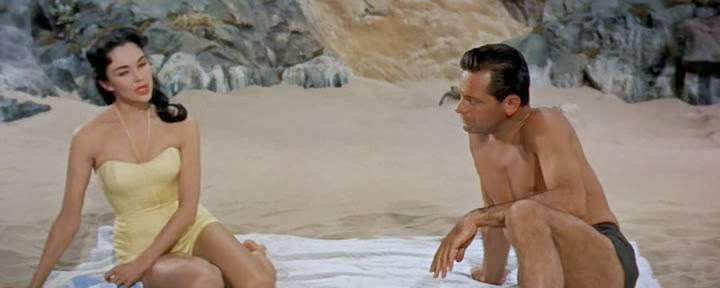
Jennifer Jones plays Dr. Han, who is doing her residency in Hong Kong in 1949. She is a widow, as her husband was a general killed by the Communists. She has a small room in the hospital itself and devotes her life to medicine. At a party given by one of the directors of the hospital, she meets Mark Elliot (William Holden). He pursues her and she at first rebuffs him. For one thing, he's married. For another, after her husband's death, she turned off her heart. Mark is persistent and she eventually falls for him, causing her to be ostracized by the greater Chinese community. Though they briefly find happiness, his wife refuses to give him the divorce he wants so he can marry Dr. Han and he eventually is shipped off to the Korean War.


This was one of the early CinemaScope films, but curiously fails to take full advantage of the process. Outside of the requisite gimmicky shots at the beginning of the point of view of an ambulance racing through the Hong Kong streets, the film doesn't really do anything with the process. Most early CinemaScope movies fill the image from left to right, especially with the placement of the actors. In this one, the actors mostly get clumped together in one area of the screen. There are some panaromic shots of Hong Kong, where the movie was actually filmed, but I guess after the opening bit, director Henry King thought, "well, there's my nod to CinemaScope. Now on with the picture." Which is odd, since those shots, like similar ones in How To Marry A Millionaire are obviously supposed to duplicate the thrill of Cinerama, something CinemaScope could never do. CinemaScope was always about the left to right image and widening that image, so it's use here is a little disappointing.

The film also fails to take advantage of the undertones of it's story. We're told repeatedly early on that Eurasians are treated badly by the British, but outside of some somewhat racist or at least clueless dialogue by the wife of the hospital's director (Isobel Elsom) at the party, this isn't evident. We're also told that Chinese  people having affairs with foreigners, especially married ones, will lead to ostracization in the Chinese community. Again, outside of two scenes of Kam Tong's Dr. Sen berating Jones for her affair, this doesn't seem to come out much, either. It's almost as if the film is afraid to commit to the difficulties it claims the couple should be having. Which is a shame, because it makes it a little bit harder to be fully invested in them and feel for them. The film only really pulls through in the emotionally charged ending, which would have been even better if it had committed to it's undertones a lot earlier.

I'm not saying that they had to go out of their way to wreck the lives of the two lovers. However, there's an awful lot of talk about things that could come to pass and very few examples of it actually coming to pass. As a result, the tension of the love affair isn't fully there. The most tension comes from whether or not Holden can get a divorce from his wife. Even that isn't fully realized. I wanted this movie to make me feel bad for these two, to really invest in them. After all, doesn't Romeo and Juliet make you feel for it's star crossed lovers by making the tensions between their families palpable? I may have to read the book to see if it expands on any of the themes the movie suggests but doesn't much get into.


What we're left with is Holden, Jones, and some lyrical dialogue. I suppose for a love story that should be enough, but it's not quite for this. Don't get me wrong. Holden and Jones are wonderful in their parts. I've never actually seen a movie Holden was in that I didn't like him. He was a terrific actor consistently and he's extremely effective here. He plays Mark as eager in the early scenes, but not overbearing or obnoxious in his pursuit of Jones.  When he tells her in the canoe "I would never do anything to hurt you", he truly sells it. As for Jones, she does the right thing and doesn't play Dr. Han as a caricature, but as a human being. I completely bought her transformation from the scientific doctor in the beginning not wanting to commit to her heart to the passionate person she becomes. That transformation is part of what makes the movie's last 20 minutes so emotionally charged, in fact. It's a little bit amazing that they seem to have such chemistry together, as by all reports they couldn't stand each other on set. There are reports that Jones ate garlic before the intimate scenes to discourage known womanizer Holden. She also apparently complained about everything on the film, including her makeup which she felt made her look old. I don't agree with her assessment if that was the case.

As far as the dialogue goes, it  really is lyrical. Some love stories have dialogue that makes you say aloud "who in the world actually talks like that?" but not this one. Maybe it's the fact that this was based on a true story, but nothing feels over-baked or sappy. In fact, as far as romantic movies go, this is probably one of the best in that regards.

The supporting cast is just that: a supporting cast. Nonetheless, there are a few amusing bits. Character actor Phillip Ahn plays Jones's Third Uncle and gets the film's most amusing line when he says "let us have tea and talk of absurdities". Keye Luke also has a bit part as a relative of Jones. Richard Loo, who later played Hai Fat in The Man With The Golden Gun and Major Chin in The Sand Pebbles, plays a rare sympathetic part as the husband of Jones's best friend.


Mention must also be made of Alfred Newman's score. It's a fairly lush score that incorporates the theme song throughout. The title theme was written by Sammy Fain and Paul Francis Webster. We get bits of it throughout before getting the full blast sung during the emotional ending. It's one of those songs you either love or it gets on your nerves. I actually like it myself. The recording by The Four Aces became a number one hit for four weeks before Rock and Roll took over the charts.

At the end of the day this is a very good movie that could have been just a little bit more. It's bouyed by it's stars but one can't help feeling it holds too much back both in it's cinematography and exploration of it's themes.But the thing that nails it and makes this movie the classic that it has become is the ending, which is guaranteed to not leave a dry eye in the house.

Tuesday, February 11, 2014

Little Miss Marker (1934)


When I heard this morning that Shirley Temple had passed away, it occurred to me that the only one of her movies I had ever seen was Fort Apache, done when she was an adult and near the end of her film career. So I knew I had to watch one of her earlier films in salute. Being a Damon Runyon fan, Little Miss Marker was the natural choice.

Little Miss Marker concerns a bookmaker who goes by the name of Sorrowful Jones, so named due to his most unhappy disposition. Mr. Jones lays a G on a race that is somewhat fixed by the gambler Big Steve. Big Steve is planning another, bigger fix which will net him 10 to 1 on a $10,000 bet. During the course of the first fix, a gambler leaves a marker with Jones in the form of a small doll named Marthy. Marthy's mother went to the Big Racecourse in the Sky already and when the gambler loses the bet, he decides it would be more advantageous to him to join her than to attempt to come up with the $20 he owes Jones for Marthy. So Jones and his friends find themselves stuck with the little doll whom they end up nicknaming Marky. The big plan seems to be to make the authorities think that Marky owns Big Steve's horse so that Big Steve can place his bets and win his money. But while Big Steve is in Chicago placing bets, his doll Bangles starts to fall for Little Miss Marker and Sorrowful. Sorrowful himself falls for the kid and starts to change his ways. Unfortunately, Sorrowful's friends are a not very good influence on Marky and she starts to become more than somewhat cynical and tough. So it comes that Bangles and Sorrowful conspire to turn Marky back into the nice doll she once was so she can eventually end up with a good family.

My apologies for my attempt at Runyon-speak, but it seemed appropriate for the movie.


Temple, of course, is Marky and it takes all of five seconds of her on the screen for one to realize why she was such a big deal in the 1930s. She absolutely bursts with personality in a way that no child star before or since her has. At the age of five, she could do everything a veteran adult performer could do: sing, dance, and act. Not mug--act. Her antics could crack you up, but when she turned on the dramatic moments, she could break your heart. The scene of her telling Bangles (Dorothy Dell) about the death of her mother is particularly touching. She switches gears mid-scene frequently and does it effortlessly. I have no idea how directors got the performances out of her that they did, but those performances are a marvel to watch. What's doubly surprising is that this is one of her earlier films.

On the adult side of things, we have Adolphe Menjou as Sorrowful. Menjou was a talented actor best known for this and the 1931 version of The Front Page. Ironically, Walter Mathau would star in remakes of both movies, both times in Menjou's part. Menjou doesn't play Sorrowful as sad-faced as Runyon described him, but he does marvelous in the part. Dorothy Dell is Bangles. This was one of only four movies she was in before she was tragically killed in a car accident at the age of 19. That's a shame as she had a great singing voice and shares a fun duet with Temple. Charles Bickford is de facto villain Big Steve. He's not in the movie a lot, but his final scene makes the character. And Lynne Overman's character Regret steals scenes whenever he shows up.


Anyone who has read Runyon's stories and watched the movies made from them know that most of the movies simply take the short story as a jumping off point and make huge changes to them. Part of that comes from the fact that many of Runyon's tales are more tragic than they are funny. The short story of Little Miss Marker in particular is a heart breaker. However, there were certain things you didn't do in 1930s Hollywood and the tearjerker ending to Runyon's tale was one of them, especially with Shirley Temple in the lead. The changes to this one are good and at least the germ of the story was there.

Ultimately, this is one of the best Runyon adaptions, especially as it isn't a pure comedy like most of them. It has a pathos to it which showed an understanding of the source material. A large portion of that pathos is set by it's irrepressible star.


Rest in peace, Shirley Temple and thank you for films like Little Miss Marker. Your films helped make the world a better place in the 1930s and they still do today.

Monday, February 10, 2014

St. Louis Blues (1958)


I've always found the 50s a fascinating decade for movies. While most people credit the 60s with changes  in the way movies were done due to the introduction of the rating system in 1968 (among other things), but if you peel back the 50s, you can see the changes that were slowly coming. Directors like Hitchcock started pushing boundaries involving sex while other directors like Preminger and Kramer pushed the boundaries of race. Studios started taking chances on films like Carmen Jones and Porgy & Bess, despite the ugly scourge of segregation in the South. Into that came St. Louis Blues, a somewhat lesser known but worthy entry.

St. Louis Blues is the story of W.C. Handy, the father of Rhythm and Blues. Handy is the son of a fire and brimstone preacher in Memphis. Rev. Handy believes there are only two types of music: God's music and the Devil's music. Anything that isn't a hymn is the Devil's music. Young W.C. (Billy Preston as a kid) is attracted to the Devil's music, naturally. Of course, he doesn't see it the same way as his dad. Rev. Handy in a particularly mean spirited moment takes W.C.'s prized horn and tosses it under a passing wagon, causing it to be crushed. Years later, the adult W.C. Handy returns from college. He's supposed to take a teaching job, but he gets asked to write a song for a politician. Torch singer Gogo Germaine (Eartha Kitt)hears the song and gets him to adapt it for her and he's off and running in a career writing popular tunes while working in the same seedy nightclub Gogo works in. His father eventually finds out and the two are estranged for years.


This film is a Jazz lover's dream. Nat King Cole plays the adult W.C. Handy. Poor Nat has drawn a lot of criticism for his performance, but he's not really bad in the film. Cole's problem can best be summed up by the fact that he was shy by nature and comes off as shy and a little awkward. But that awkwardness actually works considering the nature of the relationship between him and his father (Juano Hernandez) in the film. Singers who turn to acting are always a tricky proposition and he does better than some of the others who have tried it (though not in this film per se). Besides, anytime he sings, he commands the screen with that velvety voice he had. His rendition of the title tune is the final word in the film--as well it should be.

Eartha Kitt plays Gogo and nearly steals the film from everyone. Gogo should just be another bad girl, and yet Kitt breathes a life into her that you're not expecting. She's actually one of the more sympathetic characters in the movie, quietly championing Handy and trying to get his family to accept him as he is. Hernandez doesn't quite overdo the Rev. Handy, which would be easy to do as the character is written pretty melodramatically. The film also boasts performances by Mahalia Jackson, Pearl Bailey, and Cab Calloway. Calloway doesn't get to sing, but as the snake who owns the night club, he makes a great villain. Bailey plays the understanding Aunt Hagar. She only gets to do a couple of verses of the title tune, but she's great throughout. Ruby Dee plays Handy's fiancee, who never fully seems to know what she wants. Ella Fitzgerald gets an anachronistic cameo in one scene.. All she does is belt out a tune, but that's all Ella needed to do. In fact, the only people missing from the movie seem to be Lena Horne and Louis Armstrong.


Some people have criticized the film for playing fast and loose with the facts, jumbling events up such as Handy's blindness. But that was Standard Operating Procedure for Hollywood Biopics of the day. Come to it, it still is. Yet the film has a purpose in it's storytelling and it's a purpose that isn't immediately self-evident. 

It's interesting because this isn't a film you would instantly associate with race. Oh, sure, it's got an all African-American cast in it, but on the surface it appears to your standard Hollywood bio-pic musical that just happens to have a purely African-American cast. And yet, like the decade itself, when the layers get peeled back, you find out there's more than the surface story going on. And like Billie Holiday's famous song Strange Fruit, it's not too subtle when it drops it's bomb. Appropriately, it's Kitt who drops it right in the audience's lap. I can imagine the reaction of Southern theater owners upon seeing it, too. 


The movie was shot in VistaVision, the 65mm Hi-Fidelity film process Paramount used back in the 50s. It was one of the rare black and white VistaVision films. But considering how incredible most of the VistaVision films that have been released on Blu Ray look--in particular White Christmas, The Ten Commandments and To Catch A Thief--it's a crime that the only way to see this currently is a Standard Definition Open Matte 1:33 version on Amazon Instant Video. Paramount, Warner, Olive--Someone--needs to get this out on Blu Ray in all it's VistaVision glory. Maybe then this movie would get the attention it so richly deserves. With some of the greatest voices in 20th Century music and a message it cleverly slips in when you aren't looking, St. Louis Blues is a movie that deserves to be far, far better known that it is.

Tuesday, February 4, 2014

Zero Hour! (1957)


Having recently rewatched Airplane!, it occurred to me that I still had not seen the movie that directly inspired it, 1957's Zero Hour! starring Dana Andrews and Linda Darnell. Zero Hour! was based on a story by Arthur Hailey, who later gave us the novel Airport. It's also a movie that's practically impossible to watch with a straight face today.

Zero Hour! concerns Ted Striker(Andrews), who leads a World War II bombing raid into disaster, costing the lives of six men. No mention is made if one of them happened to be named George Zipp, but we'll assume so. He moves back to Canada and in 1956 is on the verge of getting a new job, his 13th in ten years. When he gets home, he finds that his wife (Darnell) is leaving on a plane for Vancouver with his little boy, planning to leave him forever. He buys a last second ticket for the flight (you could do that in those days) and gets onboard, hoping to convince his wife to change her mind. Disaster falls when everyone who eats fish--including the crew and Striker's young son--gets a bad case of food poisoning. Doctor Baird (Geoffrey Toone) informs Striker that he's their only hope. Vancouver Airport head Harry Burdick (Charles Quinlivan) brings in Captain Martin Trevealan (Sterling Hayden) to try to talk Striker down. Trevealan and Striker flew together during the war and have some animosity towards one another. Can Striker get the plane safely down and save all the passengers? Or will he crack up under pressure and crash the plane into the mountains? The people are getting sicker, the fogger is getting thicker, and Leon is getting larger.


I always heard that Airplane! cribbed a lot from this movie. Just how much was cribbed wasn't made clear until I actually watched it. You may have heard that ZAZ took scenes, situations, and dialogue from Zero Hour! for Airplane!, but what you may not know is just how dead on.

Elaine's line about not being able to love someone you don't respect? Check.
The doctor's line about not only finding someone who can fly this plane but who didn't have fish for dinner? Check.
Striker's line about "I may bend your precious airplane but I'll get her down"? check
"You'll have to talk him right down to the ground"? Check

And so on and so forth. I freely admit that I had to stop the movie for a couple of minutes from laughing so hard when I heard the "looks like I picked the wrong week to quit smoking" line here. I'm talking word for word here.


Mind you, Zero Hour! is not intended to be a comedy. If you can actually put Airplane! out of your head, it's a tight little thriller. The cast is good and everyone does their parts professionally, even sincerely. Andrews and Darnell were always good actors and they do their jobs well here. It's not that this is a bad movie at all. It's a decent--I would even say pretty good--movie at that.

The problem is, anyone who has seen Airplane! any number of times is bound to finish the jokes as soon as they start hearing the lines. When Burdick says, "Hey, Johnny, hope about some coffee", you can't help but say to yourself "No thanks" even if Johnny doesn't say it in this movie. When Darnell is working the radio and describing the flying conditions to Hayden, you almost expect Andrews to say "It's a damn good thing he doesn't know how much I hate his guts" and her to repeat it. When the plane captain's wife shows up in the tower at the end of the movie, you expect her to start groping Hayden as he's trying to talk Andrews down.


I almost feel guilty about laughing at this movie. But I guess in 2014, it just can't be helped. If you've never seen Airplane!--and there are such people I am told--you'll probably appreciate this more as the thriller it's intended to be. If you have seen Airplane!, you'll still want to see this just to see where the idea came from. Like I said, it's a good movie and well worth watching at least once.

Yes, I am serious about that. And don't call me Shirley.

Tuesday, January 28, 2014

Scream For Your Lives: The Tingler is loose!

Of all the directors to have come and gone in Hollywood, perhaps no other director had such a P.T. Barnum sense of showmanship than William Castle. Castle made gimmick shot laden 3D films in the 1950s before doing a string of successful gimmick films in the late 50s and early 60s. His best known gimmicks were Emergo, used for The House on Haunted Hill, where an inflatable skeleton was wheeled over the audience's heads in one scene, Illusion-O for 13 Ghosts with it's silly ghost viewer (not a 3D movie as some have speculated), and perhaps most (in)famous of all, Percepto used for 1959's The Tingler. Percepto was the gimmick where certain theater seats were wired to give off an electric shock. At a certain part of the movie, the screen goes black and Vincent Price warns the audience to scream for their lives. In order to ensure that screams would follow, yes, the seats would give off a shock. Nobody could even dare such a gimmick today but in 1959, William Castle did.


The story of the movie manages to mostly hold it's own. Vincent Price plays a pathologist with an unhealthy interest in the tingling sensation you get when afraid. He thinks that the sensation is caused by a thing which can crush spines and determines he's going to find out more about it. He scares his unfaithful wife and manages to get X-Rays of an insect like creature on her spine. Dubbing it The Tingler, he's determined to catch a specimen for study. Naturally, the best way to do this is to scare himself by using LSD. Sadly for Vinnie, he screams before the creature can kill him and thus be captured (don't ask--Vinnie is just shy of being his usual nuts self in this). Interestingly, this is the first use of LSD in a movie and unlike later movies that made taking a Trip look like a gas, this one actually makes it look kinda frightening. Vinnie might oversell it a bit, but then again maybe he doesn't. I've never actually seen someone Trip, but I'm not counting on this for authenticity either.


Luckily for him, however, the deaf mute wife of a silent movie theater owner experiences some very weird things and ends up dying of fright. A full fledged Tingler is found attached to her spine. Price detaches the creature to study it. His wife uses it to try to kill him, but a well timed scream from the wife's ward stuns the creature.


Meantime, Price figures out that the theater owner killed his wife. He takes the Tingler back to the theater to put the Tingler back in the wife's body, thinking that that would be the only way to kill the beastie. Unfortunately, the creature escapes into the movie theater itself, cueing our long awaited gimmick scene, which admittedly is pretty pointless on TV.


Vincent Price, like Bela Lugosi before him, was one of those actors who was always professional. No matter how good, bad, or indifferent the movie he was in, he always put forward an effort and was frequently the best thing about the movie.  The Tingler isn't a bad movie but it does take a while to get going. Point in fact, it takes nearly a full hour for the creature to show up, and this is only an 85 minute movie. Much of that first hour is a little too talky and in the hands of a lesser actor than Price would be almost deadly dull. The weird events that beset the deaf mute are great, but again that's almost an hour in. And while the film is somewhat suspenseful and scary when the creature is running around, some of it is pretty darn hokey and silly, too. There's a misplaced sense of timing when the creature starts into the theater with too many shots from the silent movie To-lable Dave taking away from the moment.  Compared to the movie theater scene in The Blob, released just one year before, The Tingler falls down on the job big time.


A lot of people complain that 3D effect shots in 3D movies are pretty pointless in 2D. This is true, but of all the gimmicks, Percepto is perhaps the most pointless on TV. Unless you're actually going to wire your sofa up to duplicate the effect, the shots were the screen goes black and Price urges everyone to scream for all their worth because the Tingler is loose in the theater are downright goofy and pointless. New York's Film Forum theater occasionally shows The Tingler in Percepto and I guess under those circumstances it would be more fun.


All in all though, one watches this movie wanting to like it much better than one ends up doing. Price's other Castle production, The House on Haunted Hill, is much scarier and more fun and his best work--the Corman Poe productions--was still in front of him. I won't call The Tingler a bad movie, but it could and should have been better. Watch it if you want, but watch it primarily for Price and don't expect too much out of it.

Monday, January 27, 2014

"And I Was Thankful To Have It!" or The Back-In-My-Day Post

It seems odd to me that, though I'm only 43, I'm actually writing a blog post called Back In My Day. Back In My Day is the sort of thing you usually hear cranky old men say, usually describing how horrible and tough things were and how people have no appreciation for how easy they have it today and how society has gone to hell because of it. It's also usually also tinged with nostalgia for a simpler time. I was born in the 1970s and a teenager in the 1980s. I freely admit to still enjoying music and certain movies from that time period, but I have no real desire to relive it and am actually not particularly nostalgic for it, either. Nonetheless, this is a Back In My Day post and it's being written for a reason.


Back in my day, if you wanted to see an old movie, you had to wait for it to be shown on TV. If it was a widescreen movie, it was being shown pan and scan, which meant you could be missing up to 2/3 of the picture. It was also edited for commercials, and there were commercials every five to ten minutes. And the TV screens weren't wide 16X9, they were square 4X3 screens.


Back in my day, we didn't have 110" screens with surround sound. The biggest TV we had was 25" and mono. My personal TV was 13", mono, and black and white. I watched many a late show on that TV. For those of you under the age of 20, the late show used to show movies on independent stations.


Back in my day, we didn't have Blu Ray or DVD. If you were lucky, you had a Super 8 projector with a 3 foot screen and could watch 10 to 20 minute digests of feature length movies. They were still putting these out in the 1980s, in fact. I have a 20 minute digest of The Empire Strikes Back still. If you had some money, you could get a VHS player. If you had some more money and the inclination, you could get a LaserDisc player, which gave a better image and had its movies in widescreen format. Of course, only 30 to 60 minutes of the movie would fit on a single side of a LaserDisc, so that meant either flipping the disc or changing it over. A simple two hour movie could be on two double sided discs. My family got the VHS player.


Back in my day, 3D TV was an occasional special shown on an independent station. You had to buy cardboard red and blue glasses from a local fast food or convenience store, turn out the lights, sit six to eight feet back, fiddle with the tint on the TV, and get next to no effect.


Back in my day, being a movie buff--especially a young one--really kinda sucked. The Three Stooges shorts and Looney Tunes cartoons were always cut up, Charlie Chan came on at 11 pm, and renting a movie meant going to a video store. And if the movie you wanted was out of stock...too bad so sad. Only a few video stores had a selection good enough to satisfy a classic fan. There was no On Demand or Netflix Streaming (which also sucks, but that's a different rant for a different day).


Why am I bringing all this up? Because it occurs to me that all too many movie buffs today--and not even the young ones per se--remember back in my day. And they should, because back in My day was--unless they're under the age of 25--back in their day, too.


We live in a high definition world now. We have Blu Ray with it's incredible image and sound quality. We have Surround Sound, to help put you in the middle of the action. We have widescreen TVs which allow 1:85 movies to be shown without black bars and Scope movies to be shown with minor black bars.  Our screen sizes are bigger, too. I have a 42" 3D TV. It's the largest TV I've ever had. Every so often, I think it's too small, but that's just a fleeting thought. This thing is a monster compared to what I grew up on.


When I was a teenager--or back in my day, if you prefer--the thought of seeing the 3D movies from the 1950s the way they were originally shown seemed like it would never happen. I watched most of those movies flat on TV, complete with commercial interruptions and no doubt editing. Except for the titles I saw on American Movie Classics, which were complete but also flat. Now I own four 50s titles on 3D Blu Ray, with at least one more promised to come out and have, in the past 14 years, managed to see nearly every one that still exists in 3D in the movies. I consider myself outrageously lucky in that regard. After all, 30 years ago, seeing Creature From the Black Lagoon in 3D meant tracking down the lousy anaglyphic VHS Universal released in 1980 or, if I was super lucky, seeing the anaglyphic 16mm print somewhere. Now, I not only own a 3D Blu Ray of it, which is gorgeous, I've managed to see it in the movies in full polarized 3D, exactly the way it was shown in 1954.  30 years ago, seeing Kiss Me Kate meant seeing it flat on VHS. There isn't a 3D Blu Ray of it (yet), but I have seen it on the big screen in proper 3D at least 4 times. Needless to say, I'm happy about both.


Point in fact, I have seen, either on TV or in the movies, 42 of the 43 movies that still exist in 3D prints from the 1950s. I may never get to see the 43rd in 3D, but I really can't complain about the rest of them.


I bring all this up because I have seen on the web and in person an awful lot of complaining about the so-called imperfect presentations of classic movies. The most recent bout has concerned the new Criterion Blu Ray of It's A Mad, Mad, Mad, Mad World, which has caused all manner of insane complaints, from the fact that the reconstructed footage doesn't look as good as the rest of the movie to the two or three scenes that have light Japanese subtitles to the complaints about the spaces between the radio calls during the intermission.


Good grief as Charlie Brown would say. Of course the reconstructed footage doesn't look as good. The trims were in bad shape to begin with. There's only so much that can be done. And as for the Japanese subtitles--try watching a whole movie like that. I've done it. I so wanted 3D copies of House of Wax and Dial M For Murder that for 10 years I had DVD-Rs of faded copies of the Japanese VHD disc in the field sequential format. And yes, I was thankful to have them.


When I first saw It's A Mad, Mad, Mad, Mad World, guess what? It was the short version. On TV. In Pan and Scan. Mono. Edited for commercials. With the ending lobbed off, too! I didn't even know there was an intermission until someone taped the LD version off of TCM for me about ten years ago. Maybe I'm the easiest person in the world to please--I'm sure someone could accuse me of that--but I'm pretty happy getting to see this new extended version. Is it perfect? No, but I kinda knew that going in. Is it better than what I first saw 30 years ago? Oh, God, yes. I am in no way outraged by this Blu Ray. I am, however, a little outraged and disgusted by the people who are screaming that the Blu Ray is a rip off since it's not exactly what they want. Seriously? Seriously? Anyone who thinks that seriously needs to get a grip. This Blu Ray is far from a rip off.


Similarly, I went to the World 3D Film Expo III back in September in Hollywood. I'm surprised that this is my first mention of it on this blog as it was a really wonderful experience, but then again it may be like my friend Bob Bloom once said: when people enjoy something, they don't talk about it. They only talk if they hate it.


Well, I didn't hate the 3D Film Expo. I loved it. 10 days, 35 movies, 31 of which were from the 1950s. Some extremely rare material, including the 1947 Russian version of Robinson Crusoe. I was in my element for those 10 days, you can believe it. I am also willing to bet that that was my last time getting to see most of those movies in 3D. I think if I'm ever going to get to see them again, it'll be in boring old 2D. Some of them might hit 3D Blu Ray, some of them might get shown again in NYC. But I think I won't get to see quite a few of them in 3D ever again. Some of them, the last time I saw them in 3D was in 2006 at the second World 3D Film Expo. So yeah, it was pretty special for me.


Which is one of the reasons why certain people at the Expo drove me bonkers. They would sit in their seats and throw near full on temper tantrums about the presentation of some of the titles. One guy was literally slamming his fists on his chair because--are you ready for this?---Phantom of the Rue Morgue was being shown in 1:85 and not 1:33 like he wanted it to be. Really? Beyond the fact that 1:85 was the proper aspect ratio for the movie, really? How childish does one get? I could see getting up in arms if the movie was being shown out of sync, but it wasn't. Hell, I would have complained if it was out of sync, since that's a perfect way to get a 3D headache. But complaining that it's not in the aspect ratio you want it to be? Again, a grip needs to be gotten.


Part of the problem, I think, is that movie buffs--or at least certain ones--are so hung up on the presentation that they can't really sit back and enjoy the movie itself. All too often, I see complaints of one absurd nature or another--one guy complained about seventeen seconds of Digital Noise Reduction being used during opening credits (though nowhere else in the movie he admitted)--but nobody actually talking about the movie. Yes, we do have a right to expect certain movies to look perfect on Blu Ray--there's really no excuse for a new movie looking anything less than perfect and there are quite a few classics like The Wizard of Oz or Casablanca that should look perfect. But there are films that are rare and that rarity should be kept in mind far more than any perceived imperfections. Being able to see that rarity should also be cause for joy, not childish anger because it's not precisely what you want. You don't always get precisely what you want--and sometimes you don't deserve it either. I am of the opinion that more movie buffs should stop and consider the marvel of what they're seeing and be glad to see it once in a while. Because you never know. Something like it may never come around again.


Besides, back in my day, everything had imperfections. But we watched them and were thankful to have it!

Sunday, January 26, 2014

It's A Mad, Mad, Mad, Mad World

After several years of making serious--and somewhat depressing--message films, director Stanley Kramer decided to try to make THE comedy of all time. So he gathered most of the greatest comedians of the day, took a huge script that by legend was two scripts--one for dialogue and one for action--and gave us It's A Mad, Mad, Mad, Mad World, a film that originally ran almost as long as The Ten Commandments. Point in fact, the first actual cut was, according to legend, 5 1/2 hours. It was trimmed down to 210 minutes (3 1/2 hours) before being cut back to 202 minutes. It played at that length for four weeks before being trimmed down to 163 minutes. 9 additional minutes--consisting of the overture, intermission, entr'acte, and exit music were then cut out leaving the movie at 154 minutes. For roughly 30 years, this was the only version possible to be seen. It was the version I first saw when a local station would run it on New Year's Day. And they cut it even further than that, even lopping off the very ending of the movie.


In 1991, roughly 20 minutes of 70mm trims were found and put back into the movie along with the overture, etc, bringing the movie up to 182 minutes. That version was released on VHS and Laserdisc (remember those?) and became, for the most part, the fan favorite version. However, MGM never properly restored the footage, so when the DVDs and first Blu Ray came out, it was the 163 minute version. Fans howled for the longer version and it looked like it would never happen. However, this past week, The Criterion Collection, through the efforts of Film Restorationist Extraordinaire Robert A Harris, put together a 197 minute version, which is probably as close to the original Roadshow as we're ever going to get.


The movie involves a group of motorists who witness a horrific (but spectacular) car crash on a California road. They try to help the driver of that car, a gangster named Smiler Grogan (Jimmy Durante), but he's already dying. Before he (literally) kicks the bucket, he tells them about $350,000 he's hidden under a "Big W" in Santa Rosita State Park. The motorists fail to tell the cops (one of whom is Norman Fell) about the money. They decide instead to go dig the money up themselves. At first, they try to work out a plan where everyone gets shares. But it takes no time at all for them to decide that it's every man--"including the old bag"--for himself and a wild chase for the money ensues. Unknown to the participants, they are being watched by the police, especially Santa Rosita Capt. T.G. Culpepper (Spencer Tracy), who wants someone to lead them to the money. Others get involved, wanton destruction of personal and private property ensues and the film just gets more and more frantic as it goes along.


Like quite a few epics from the 1960's, this film is rife with cameos and guest appearances. Not quite everyone who was someone in comedy is in it, but it comes close. If you know anything about classic comedy from the first six decades of the 20th Century, you'll be delighted at spotting all the actors. The principals were mostly TV actors at the time--Sid Caesar, Milton Berle, Buddy Hacket, Jonathan Winters, Dorothy Provine, Edie Adams, Ethel Merman, and Mickey Rooney are the primary motorists who kick the whole thing off. Phil Silvers, Terry Thomas and Dick Shawn end up entering the race, as does Peter Falk and Eddie "Rochester" Anderson. Along the way, there's appearances by Jack Benny, Jerry Lewis, Sterling Holloway, Paul Ford, Edward Evert Horton, The Three Stooges, Don Knotts, Buster Keaton, Carl Reiner, Arnold Stang, Marvin Kaplan, Leo Gorcey and Jim Backus. On the side of the cops we have Alan Carney, William Demearest, Harry Lauter, Roy Roberts, Zazu Pitts, and Madalyn Rhue. Selma Diamond is the voice of Spencer Tracy's wife. And the list goes on.


Some people have complained that all the cameos make the film distracting to watch, much like The Greatest Story Ever Told. Frankly, I find the latter film much more distracting with it's cameos. It's hard to take a movie about Jesus seriously when you have the actor who played Klinger as one of his disciples, Sidney Poitier helping to carry the cross, Charlton Heston screaming "Repent!" for ten minutes as John the Baptist, and John Wayne as a Roman Centurion wearing a wristwatch and saying "Truly this man was the son of God". In Mad World, the cameos fit. The only sad thing is that many of the cameos will be lost on a lot of young people. It's like watching The Muppet Show nowadays--some of the stars may be remembered and quite a number of them get the question of "Who?". Yes, if you know classic comedy, then almost everybody in the movie will pop out at you. If you're under a certain age, however, it's possible that the only people you may recognize now are Jonathan Winters, Peter Falk, The Three Stooges and Jim Backus. And even poor Jim Backus is a little shaky in this day and age. Actually, you might be surprised to that you would know more of the people than you would think, For instance, Jimmy Durante is the narrator of Frosty the Snowman (Jonathan Winters did the same duty for the awful Frosty Returns). Sterling Holloway was the voice of Winnie the Pooh (and Kaa the Snake in The Jungle Book). Edward Evert Horton narrated Fractured Fairy Tales on Rocky and Bullwinkle. Selma Diamond was on Night Court and in the Steve Martin movie All of Me. Don Knotts did a couple of movies with Tim Conway for Disney like The Apple Dumpling Gang. Jack Benny did a Looney Tunes cartoon spoofing himself (Rochester was in it, too) called The Mouse That Jack Built. Ethel Merman is in Airplane! as herself. Dick Shawn voiced The Snow Miser in The Year Without a Santa Claus. Carl Reiner is in the Clooney Oceans 11 trilogy. Sid Caesar is the gym teacher in Grease. And so on. Do a little research and you may be surprised.


Everybody who was in the movie was a great in their field. Spencer Tracy is one of the finest actors who ever lived. He's essentially playing the straight man in this and he's terrific as Culpepper, whose life slowly unravels during the course of the movie. He holds our attention whenever he's onscreen, even when he's just walking around. As for the comics...well, what can be said? Everyone will have their own favorite among the leads--Jonathan Winters seems to be the biggest favorite, with his hysterical destruction of Kaplan and Stang's gas station one of the best set pieces in the movie. It is to be hoped that should young people actually watch this that they may seek out other works from these great comedians to see what they've missed. I'm probably dreaming there, but I'm allowed.


Funny enough, there's nothing really in the movie to actually date it. Most comedies, even the truly great ones from the past forty years like Blazing Saddles and Airplane! have humor or other elements that firmly put them in their era. It can be argued that Airplane! is funnier than Mad World, but the disco scene--funny as it is--makes it a product of 1980. But the only thing outside of the cars to date Mad World is the appearance of pay phones. Everything else is timeless. The movie could literally have been shot at any given time. That could be why it still works so well and remains so funny. The complete lack of topical humor is the genius of the movie. You could watch it two hundred years from now and the jokes still wouldn't date. Two hundred years from now, people are going to watch Airplane! and scratch their heads at the disco scene (sadly). I'm not knocking Airplane!, mind you. I love the film and it's one of only a few comedies I bothered getting on Blu Ray (I by and large don't need to see comedies in hi def), but the reality is that it's already dating badly while Mad World manages not to.


Oh, and for the young people who wonder why Ethel Merman just doesn't pull out her cell phone to call her son, the answer is they didn't have them back then.


The Criterion Collection Blu Ray is a joy for fans of the film. It includes the "general release version", that is the 163 minute version in gorgeous high definition. But it also includes the reconstruction of the Roadshow version. Now again, this is a reconstruction, so parts of it aren't perfect. Remember, MGM didn't restore the trims, so Criterion could only do so much with them. As a result, there's a noticeable shift in quality whenever the film goes to restored footage. Some restored footage has burned in Japanese subtitles, which are fortunately a little light and small and not particularly obtrusive. Sometimes they have picture but no sound, so subtitles show up. And in at least four or five scenes, there's audio but no picture, so stills get used instead. That, to use Dick Shawn's slang, tends to bug some people, but I'm fine with it. None of those sequences are particularly long and at least three of them explain certain things that happen within the movie. At least one is full on hilarious and never should have been cut and one has a major plot point in it. It's also loaded with great extras, including the most fascinating commentary track I've ever heard. The track not only has great info on who was in the movie but who wasn't in the movie. Bob Hope, Lucille Ball, Ed Wynn and Groucho Marx among others were penciled in but didn't make it.


The Blu Ray also reinstates the police calls that played during the films intermission. Those radio calls are interesting since they clear up a couple of plot points in between the two acts. The history of those calls is that they were piped in throughout the theaters during the original Roadshow engagement until a little old lady complained that they made her think strange men were with her in the ladies room. I'll leave the snarky comments about that to my readers.


This Blu Ray is an absolute joy. Like Twilight Time's Man in the Dark release this week, it's a must buy for anyone who owns a Blu Ray player. The restoration by Robert Harris truly adds to this wonderful movie. All of the general release footage is amazing to look at and the reconstructed footage, though not as nice, doesn't look that bad either. There's some great extras, including a five minute piece on how the restoration was pulled off. Being a Criterion release, the disc is a little pricey--49.95, dual format DVD and Blu Ray, but then again it is 5 discs, so that works out to $10 a disc. "And that's tax free money, my friend." At any rate, it's well worth the purchase. Extremely highly recommended.

Thursday, October 24, 2013

3-D Thursday: Amityville 3-D (1983)

Amityville 3-D holds the distinction of being the last of the major 3D releases of the 1980s. A few more independent films limped out in 1984 and 1985, but this November 1983 release was the effective end of the road for the process for nearly 20 years (a couple of minor 1990s releases notwithstanding).

It also holds the distinction of being on Siskel & Ebert's Worst of 1983 list. I'm not entirely convinced I agree with that distinction, however. After all, 1983 also gave us The Man Who Wasn't There and Metalstorm: The Destruction of Jared Syn, both of which threaten to make this film look like Casablanca.

The funny thing about this is the fact that, like so many other bad movies, one watches Amityville 3-D and is left wondering just how it went so wrong. It shouldn't be as bad as it is. It has a decent enough cast, a pretty good idea for the story, and the director of such classics as 20,000 Leagues Under the Sea, Fantastic Voyage, and Tora! Tora! Tora!. Despite all this, the film manages to lay an absurdly sour egg.

The story has magazine journalist John Baxter (Woody Allen alumni Tony Roberts) buying the Amityville Horror house. As he makes his career debunking hoaxes, he doesn't believe in the stories about the house. So far so good. I can dig a guy with cajones buying up a haunted house. Of course it doesn't take long for weird stuff to happen and people to start dying. Baxter, for his part, just blows it all off.

The Realtor who sold him the place dies in the house? Happens all the time!
Baxter's photographer partner Melanie gets attacked by the house and later is burned to a crisp in her car? Mere coincidence!
Baxter's daughter drowns after a séance where the house threatens her? It's tragic, but what can you do? That's life!

Sheesh, is this guy boneheaded! In fact, Baxter is hilariously boneheaded even after he's attacked in an elevator. Me? I would have been suspicious after the realtor, concerned after the elevator, and convinced after my photographer died. But then, I'm not the victim of bad screenwriting.

The script is just one of the frustrating things about this film. There seem to be two types of people in this movie: stupid people and whiney people. As stupid as Baxter comes across, it can't beat the stupidity of paranormal investigator Eliot West (Robert Joy). This genius decides that the best way to save Loughlin's spirit from the demon in the well is to lean near the well and, when he sees the demon coming up yell to her spirit to save herself. That's it. Naturally, the demon gets him instead. Good plan, there, bub. Didn't think to bring any holy water or anything, did you?

While it's true that none of the 1980s 3D movies are what you would traditionally call "good movies", this one should have been. Besides Roberts and Joy, Candy Clark plays Melanie, Lori Loughlin is the daughter, and Meg Ryan her best (only?) friend. Yes, that Meg Ryan. So this isn't exactly the cast of a Friday the 13th movie. I know, I know. Someone is going to point out that some of those movies have good casts. They don't. What they usually have is one or two (if that) good actors and a bunch of nobodies. This cast isn't a bunch of nobodies. They're a good cast doing a lousy job.

The only one who almost acquits herself is Loughlin and she doesn't get much to do. Even worse, almost all of her scenes are with Ryan, who is embarrassingly bad here. How bad is Ryan? Her performance has all the subtlety of a nuclear explosion. It's bizarre to think that by the end of the decade she'd being doing movies like When Harry Met Sally. Watching her here, however, you would swear she was never going to be anybody.

You can almost excuse those two, however, since they actually were nobodies at the time. Candy Clark, on the other hand, had been in American Graffiti ten years earlier, so she has no excuse. She starts out okay but as the film goes on her performance gets steadily worse. Her next to last scene, where Roberts tries to find out what happened to her in the house is so bad it's painful. Her death by spontaneous combustion scene is so over the top ridiculous as to be unintentionally funny.

Roberts ex-wife is played by an exceedingly shrill Tess Harper. Literally, all she seems to do is whine her way through the part. In fact, she is so annoying, you actually wish she was in the car with Clark when it goes up in flames.

As far as Roberts goes, he plays Baxter in such a blasé manner as to defy belief. You would think that an actor who worked with Al Pacino and Woody Allen would be able to bring some life to his character. But he doesn't, which makes it impossible to feel anything for him but contempt for being so stupid and banal a character. Not good for an actor who has to carry a whole movie. It's like watching a Friday the 13th movie where the character stands by the open door screaming while Jason slowly walks over to them instead of running like hell. They literally deserve what they get.

True, it's not necessarily the fault of any of the actors as the characters themselves are written that way. But the fact that none of these people--except for Ryan who goes way over the top--can make their characters the least bit interesting damns the whole project. And Ryan isn't interesting, she's just goofy and over the top.

Director Richard Fleischer had worked in 3D 30 years earlier with a movie called Arena, so he was better qualified to work with the process than any other director of an 80s 3D movie. He knows plenty about depth and it shows since the depth in the movie is fantastic, far better than most 3D movies today. But the film suffers from what all 80s 3D movies seem to suffer from: so many gimmick shots that many of them are just plain silly. Clark's charred corpse is pretty effective but it's hard to take a movie seriously that spits straws and Frisbees at you. Especially when the Frisbee effect is handled pretty clumsily. Still, if you have a 3D TV and are going to watch this movie, the 3D Blu Ray is the way to go.

In the end, Amityville 3-D ends up being only moderately better than most of it's contemporaries. This, Jaws 3-D, and Spacehunter: Adventures in the Forbidden Zone remain the best of the 80s 3D movies. But that's not really saying much.

Though I will give the movie this: there is at least one effectively creepy scene in the movie. Harper is in the house and she sees a very wet (and silent) Loughlin walking up the steps. She follows her right up to the attic and gets the door slammed on her. What she doesn't know is that outside at that very moment, Roberts and some paramedics are trying desperately to revive the already dead girl. It's a well done sequence which shows what the movie could have done with a little more effort. Shame there weren't more scenes like it.

Thursday, October 11, 2012

3D CLASSICS COME TO BLU RAY

This month has seen the release of two classic 3D movies on 3D Blu Ray for the first time--and no, I don't mean AVATAR and THE AVENGERS (which came out last month anyway). Last week Universal released CREATURE FROM THE BLACK LAGOON in 3D as part of the UNIVERSAL MONSTERS Blu Ray set and this week Warner gave us Alfred Hitchcock's DIAL M FOR MURDER. I've only spot-checked the two discs--ok, I've watched half of DMFM already--but I'm impressed with what I've seen. This is what 3D should look like. Outside of a few titles like HUGO and THE ADVENTURES OF TINTIN, most modern 3D movies aren't that impressive in terms of depth and/or effect shots. So if you think of THE AVENGERS as the ultimate 3D movie, you've seen nothing.

The 50s films were not shy about either depth or effect shots. This is not to say that those films were like their 80s counterparts throwing everything including the kitchen sink at the audience. They concentrated mostly on depth and keeping things behind the stereo window. However, when there was a gimmick shot, it was usually a memorable one. A perfect example of this is in DIAL M FOR MURDER.

For the better part of the first 45 minutes all of the action takes place behind the screen.  All this time we follow along as Ray Milland plots the murder of his wife, peering around lamps as if spying and being a co-conspirator. Then comes the movie's big moment when Anthony Dawson tries strangling Grace Kelly. Kelly desperately reaches out of the screen, almost as if imploring the audience for help. When she reaches it, it's a creepy and effective moment. We go from being in on the plot to being begged for help by the victim and not being able to do anything. It is, perhaps, the ultimate in audience manipulation and something completely lost in 2D showings.

Admittedly, DIAL M is far more subtle than CREATURE in terms of both depth and gimmick shots. But this does not make either film better or worse. CREATURE is a decent movie in it's own right and has an excellent use of 3D, especially in the underwater scenes, which are better than what JAWS 3D pulled off nearly 30 years later. The 3D really pops in this one, with fantastic levels of depth throughout and CREATURE even manages to be deeper than DIAL M. In fairness, Hitchcock confined his film to a Lomdon flat while director Jack Arnold has a jungle/water setting to play with. Arnold also uses more gimmick shots than Hitchcock. But, there's an important thing to bear in mind with Arnold's 3D films: (again) unlike their 80s counterparts, the gimmick shots related to the movie. For those who grew up seeing yo-yos and popcorn being tossed at the audience in FRIDAY THE 13TH PART 3, the idea of 3D movies not just tossing any old thing out of the screen may seem like a weird idea, but it's the center of both of these releases. I mean, Jack Arnold decided that a primary 3D effect for CREATURE FROM THE BLACK LAGOON should be the Creature himself clutching and clawing at the audience. Who knew? Then again, most modern 3D movies don't bother much with gimmick shots themselves. Then again, all too many of the modern ones are converted from 2D.

 This Blu Ray marks the first time CREATURE has been released (officially)  on home video in 3D since MCA put out a rotten anaglyphic VHS in 1980. I admit to having loved watching that release for years, but after seeing the Blu Ray, I'm convinced I was on good drugs I didn't even know I was on for all those years. This is the way to see CREATURE, unless you happen to get a chance to see it in dual strip polarized in the theater sometime. I got to see it that way twice myself and it's quite a treat. But this is definitely the next best thing. As for DIAL M, this is the first time since the Japanese VHD Disc in the 1980s that Dial M has gotten a home 3D release. Both look great on 3D Blu Ray, though CREATURE has some vertical misalignment issues. Depending on things, some eyestrain may be had while watching CREATURE. But that's the way the film has always been. It's also worth noting that both of these releases are the first time on home video that either film has been shown in it's original 1:85 aspect ratio.

In both cases, the image detail is beautiful. I noticed for the first time the bruise marks on Grace Kelly's neck the day after the attack. Okay, it was make up to look like bruise marks, but the point is that detail was never noticed by me before. Similarly, details in the shirts Julia Adams wore in CREATURE were made more apparent. Of course, that's the beauty of Blu Ray to begin with--that details you normally wouldn't notice become apparent. Both films look just fine and are well worth getting.

In fact, that's the bottom line. If you have a 3D TV, you seriously need both of these releases. They are truly top of the line films and ones you want to show people to show off your 3D system. The only one I can think of that can compare to them is HUGO, point in fact. And both releases have the promise of future classic 3D movies being brought to Blu Ray. Warners has already announced HOUSE OF WAX and Universal seems to be working on IT CAME FROM OUTER SPACE and REVENGE OF THE CREATURE. Now if Paramount would only correct their error and put HONDO out on 3D Blu Ray, all would be right with the world. Sort of. Kind of. Not really.